Beijing in Winter: What the Quiet Months Change About Opening Patterns, Light, and What Gets Cheaper
Beijing in winter: what the quiet months change about opening patterns, the light that photographers chase, the smog that closes summits, and which costs

Beijing in Winter: What the Quiet Months Change About Opening Patterns, Light, and What Gets Cheaper
You are booking a trip, and the pricing looks good, but you need to know what actually changes beyond the thermometer. Beijing in winter is a season of specific trade-offs that affect every sight, every meal, and every minute you spend outside. The heating season runs November to March, and that period brings AQI spikes that can close the summit of Jingshan Park without warning and make an N95 mask essential on bad days. Chinese New Year shuts down many hutong restaurants for days, and park closing times shift 60 to 90 minutes earlier. But the low winter sun produces the best light for photography at the Forbidden City and Temple of Heaven, and hotel rates in 4-star and 5-star properties drop 30 to 50 percent from the October peak, except during the Chinese New Year holiday itself.
Beijing Winter Travel: What You Actually Lose and Gain
The honest ledger of a December or January trip runs like this. You lose: reliable air quality, spontaneous restaurant access during the holiday period, and access to certain outdoor viewpoints. You gain: empty squares, light that makes photographs look professional, and a bed in a central hotel for less than half the October rate.
Air Quality And The N95 Mask Reality
PM2.5 levels rise during the heating season. Temperature inversion and increased coal heating in surrounding regions drive the pattern. Check the AQI daily using the China National Environmental Monitoring Centre's Beijing Air Quality app. When the number climbs above 200, indoor museum and gallery attendance rises noticeably because locals and visitors alike retreat. Carry an N95 mask between November and March. Do not rely on a cloth mask for smog spikes.
Jingshan Park Summit Access
The summit of Jingshan Park, which offers the definitive rooftop panorama of the Forbidden City, closes during smog spikes. The decision is not announced days ahead; it happens when conditions deteriorate. If clear sky is your priority, check the AQI forecast before you plan your Jingshan visit. The park's winter closing time is 60 to 90 minutes earlier than summer, so arrive by mid-afternoon regardless.
Restaurant Shutdowns During Chinese New Year
Many local restaurants, especially small hutong operations, close for days during the Chinese New Year period. The 2026 date is February 17; the 2027 date is February 6. The travel rush runs about 40 days, beginning 15 days before the holiday. Even major chains like Quanjude and Da Dong operate with reduced wait times outside that week, but the smaller spots you want to try may simply be locked. If you travel during that window, confirm each restaurant's closure dates in advance via their official WeChat account.
Beijing Off-Season: the Months That Change Everything
Off-season in Beijing runs from November to mid-January, then again after the Chinese New Year travel rush ends in late February or early March. The differences are not subtle.
What Closes Earlier
Every major sight shifts its hours. The Forbidden City's last entry is 90 minutes earlier than summer, varying with sunset. The Temple of Heaven park closes 60 to 90 minutes earlier, and its historic buildings close 60 minutes earlier. The Summer Palace closes 60 minutes earlier. The Great Wall at Badaling and Mutianyu both close 60 to 90 minutes earlier. Jingshan Park, Beihai Park, and Beijing Zoo all close 60 minutes earlier. The pattern is consistent: you lose an hour to 90 minutes of afternoon sightseeing time across the board.
What Gets Cheaper
Hotel rates in 4-star and 5-star properties drop 30 to 50 percent from the October peak, excluding the Chinese New Year period when rates spike to the annual maximum. Domestic flight fares drop from November to mid-January, excluding the travel rush. Wait times at major duck restaurants drop 30 to 50 percent outside Chinese New Year week. The crowds at outdoor attractions drop 40 to 60 percent from October levels. The trade is real: shorter days and colder weather for dramatically fewer people and lower prices.
What Disappears Entirely
Some experiences are off-season only. The outdoor ice rinks at Shichahai, Beihai Park, and the Summer Palace's Kunming Lake operate only when ice thickness reaches the safety threshold, usually late December to early February. The Longqing Gorge ice lantern festival runs during that same window. The temple fairs at Ditan Park, Longtan Park, and Changdian are concentrated in the first seven days of Chinese New Year. None of these exist in summer. If you want them, you must come in winter.
Beijing Winter Smog: When to Stay Indoors and What to Do Instead
Winter smog is the single most disruptive factor in a Beijing winter trip. It is not constant, but when it hits, it changes your plans.
Reading The AQI
The China National Environmental Monitoring Centre publishes official data via the Beijing Air Quality app. A reading above 200 triggers a noticeable shift in behaviour: museum and gallery attendance rises as people move indoors. Below 100, you can sightsee normally. Between 100 and 200, wear the N95 mask during prolonged outdoor exposure. Above 200, consider rescheduling outdoor sights entirely.
Indoor Alternatives For Bad Air Days
The National Museum of China requires advance booking and releases tickets 7 days ahead at 17:00 Beijing time. The entry cap is 15,000 visitors per day. It is closed on Mondays year-round. The Capital Museum is less crowded and also requires booking. The White Cloud Temple, an active Daoist temple, offers a quieter alternative to the Lama Temple on days when you want to be indoors but not inside a museum. The Beijing Ancient Observatory, with Ming astronomical instruments on the old city wall, is compact and covered.
The Clear Sky Advantage
On days when the AQI drops and the sky clears, move fast. Winter light at the Forbidden City and Temple of Heaven is the best of the year. The low angle of the sun between 07:15 and 07:35 at sunrise and before the 16:50 to 17:15 sunset window produces a sharp, angled light that flattens shadows on the marble and red lacquer. Photographers who visit only in spring or summer miss this entirely.
Beijing Winter Attractions: What is Actually Worth the Cold
Not every sight works in winter. Some are better, some are worse, and some only exist in these months.
The Ice Rinks And Ice Lanterns
The outdoor ice rinks at Shichahai, Beihai Park, and the Summer Palace operate only when the ice is thick enough, usually late December to early February. Check the official park WeChat accounts for the opening date each year. The Longqing Gorge ice lantern festival, about 90 minutes from central Beijing, is a winter-only attraction built around carved ice structures lit at night. Bundle up; the gorge sits in a mountain valley and temperatures drop below the city's already cold baseline.
The Temple Fairs
The Ditan Park temple fair runs during the first seven days of Chinese New Year. It is the most accessible major fair for a visitor staying in the central districts. Longtan Park and Changdian also host fairs. These are crowded, loud, and eating-focused. Entry fees are charged at the major sites; smaller neighbourhood fairs are free. If your trip dates overlap with Chinese New Year, build your itinerary around the fair schedule rather than the regular sight list, because many standard attractions will be packed or operating on holiday hours.
The Forbidden City In Low Season
The Forbidden City is closed on Mondays year-round, except during national public holidays. Winter last entry is 90 minutes earlier than summer. The entry cap remains 80,000 visitors per day with timed slots, but in winter the cap rarely fills outside the Chinese New Year period. Tickets release 7 days in advance at 20:00 Beijing time via the official WeChat mini-program. The practical failure is underestimating the walk: from the entry gate through security, across Tiananmen Square, and out the north gate to the nearest metro takes about 90 minutes just in transit. Budget 3.5 hours minimum for the interior, more if you want to see the galleries.
The Great Wall In Winter
Badaling and Mutianyu both close 60 to 90 minutes earlier in winter. The Mutianyu toboggan slide closes in rain, snow, or ice, and winter closure days increase. Jinshanling requires 2 to 2.5 hours by car and is partially restored with far fewer crowds. The trade for the cold is dramatic: snow on the wall, clear visibility at higher elevation, and a crowd absence that makes the experience feel private. Arrive by 09:00 to have enough daylight. The sun sets by 17:00 to 17:15, and you do not want to be on the wall after dark.
Beijing Winter Light: Why Photographers Come in January
The low winter sun produces a quality of light that summer cannot match. Sunrise runs from 07:15 to 07:35 across December and January. Sunset runs from 16:50 to 17:15. On the winter solstice, daylight lasts approximately 9 hours 20 minutes. That short window concentrates the best photography conditions into the middle hours of the day.
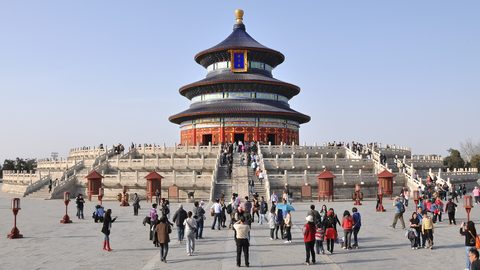
The Temple of Heaven's circular hall catches the sun at a low angle that illuminates the blue tiles and gold finial without the harsh overhead glare of July. The Forbidden City's marble balustrades and red walls take on a texture that is lost in flat summer light. The Hall of Supreme Harmony faces south, so the morning light hits it directly. Arrive by 08:30, enter through the south gate, and shoot the main courtyard before the sun climbs above the roof ridge.
The failure case is arriving at 14:00 in December and finding the key buildings already in shadow. Plan your photography itinerary around the winter sunset range, not the summer hours you are used to.
What Gets Cheaper and What Spikes: Hotel Rates and Flight Patterns
Hotel rates in 4-star and 5-star properties drop 30 to 50 percent from the October peak, excluding the Chinese New Year period. A room that costs ¥1,200 in October may cost ¥600 in December. The exception is the 7-day Chinese New Year holiday, when rates spike to the annual maximum. If you travel during that week, expect to pay peak season prices for an off-season experience.
Domestic flight fares drop from November to mid-January, excluding the travel rush. International flights do not follow the same pattern. The cheapest window for domestic connections is the two weeks between the end of the National Day holiday in October and the start of the November heating season, then again from mid-January until the Chinese New Year travel rush begins.
Wait times at major roast duck restaurants drop 30 to 50 percent outside Chinese New Year week. At Quanjude and Siji Minfu, you may walk in at 12:30 without a reservation. Hot pot chains like Haidilao and Donglaishun see the opposite pattern: wait times rise 20 to 40 percent on weekend evenings from November to February. People eat hot pot in winter. Book ahead.
What to Wear and How to Get Around
The average December high is 3°C; the low is -6°C. January averages 2°C high and -8°C low. February averages 5°C high and -6°C low. Snowfall averages 2 to 3 days per month across all three months. The prevailing wind is north to northwest at a steady 10 to 20 km/h, gusting higher during cold fronts.
Thermal base layer, mid-layer fleece or wool, windproof outer shell. Insulated boots with tread for ice. The metro runs from 05:00 to 22:30 or 23:00, line-dependent. Station exits are numbered, and exiting the wrong gate can mean a 15-minute walk to correct it. Taxi-hailing wait times increase during snowfall and temperatures below -8°C.
Bicycle-sharing remains available year-round, but usage drops below -5°C and during snow cover. Street food vendors at Wangfujing and Nanluoguxiang drop by 30 to 50 percent in January and February. Seasonal fruits at stalls shift to hawthorn and persimmon from November to January, then strawberries from February to March.
Beijing Winter Travel: Who Should Go and Who Should Skip it
Beijing in winter suits history obsessives who want the Forbidden City and Temple of Heaven without the crowd, photographers chasing the low-angle light, and repeat China visitors ready for a dense urban challenge. It also suits budget travellers who can book a central 5-star hotel for half the October rate and tolerate the cold for the savings.
It does not suit first-time Asia travellers seeking a gentle, walkable introduction. It does not suit people with significant respiratory issues who cannot risk AQI spikes. It does not suit travellers who rely on spontaneity and dislike rigid pre-booking, because the passport requirement at every landmark, the timed entry slots, and the holiday closures eliminate improvisation. And it does not suit anyone who thinks a 20-minute walk between metro exits is a minor inconvenience, because in Beijing in winter, that 20-minute walk is across a six-lane intersection in -8°C wind.
The single thing that most often goes wrong: visitors book the Forbidden City for a morning and a separate afternoon sight, then lose 90 minutes just walking from the entry gate through security, across the square, and out the north gate to the nearest metro, arriving at their second sight after last entry.
Read next
-
 Beijing Hotels What Each Price Band Actually Gets You
The most useful fact about Beijing hotels is that not every bed in the city is legally permitted to take your money.
-
 Where to Stay in Beijing District by District and What Each Costs You
Where to stay in Beijing depends on whether you prioritise imperial proximity, nightlife, or calm.
-
 Flying into Beijing PEK or PKX and Getting Out of Both Airports
Flying into Beijing: choosing between PEK and PKX, and exactly how to get from each airport into the city centre without getting stranded after a long flight.
-
 Beijing Things to Do Ordered by Whether It Is Worth the Time
Beijing consumes your day before you see anything. The walk from Tiananmen Square metro exit to the Forbidden City gate is a long stretch of open concrete und
-
 Best Time to Visit Beijing What Each Season Does to the City
The most common mistake travellers make about Beijing is searching for a single perfect month. There is none.
-
 Getting Around Beijing Without Wasting Half the Trip
On a single morning in Beijing you will: tap a QR code to enter the metro, scan your passport at a landmark ticket counter, pay for a jianbing from a cart
-
 Forbidden City
The Forbidden City runs on a strict one-way route with a single entry and exit. Here is how to plan the Beijing visit without queueing twice.
-
 Temple of Heaven
How to visit the Temple of Heaven Beijing without queueing twice: the two-ticket system explained, which gate to use, and why the through ticket saves you a
-
 Summer Palace
How to visit the Summer Palace Beijing without queueing twice: the two time windows that avoid tour buses, which gate to enter, and why walking direction