A Gazetteer for Travellers Heading to Japan
A rail network that reshapes your itinerary, a cash culture that endures alongside futuristic tech, and two brief seasons that carry the weight of a nation's
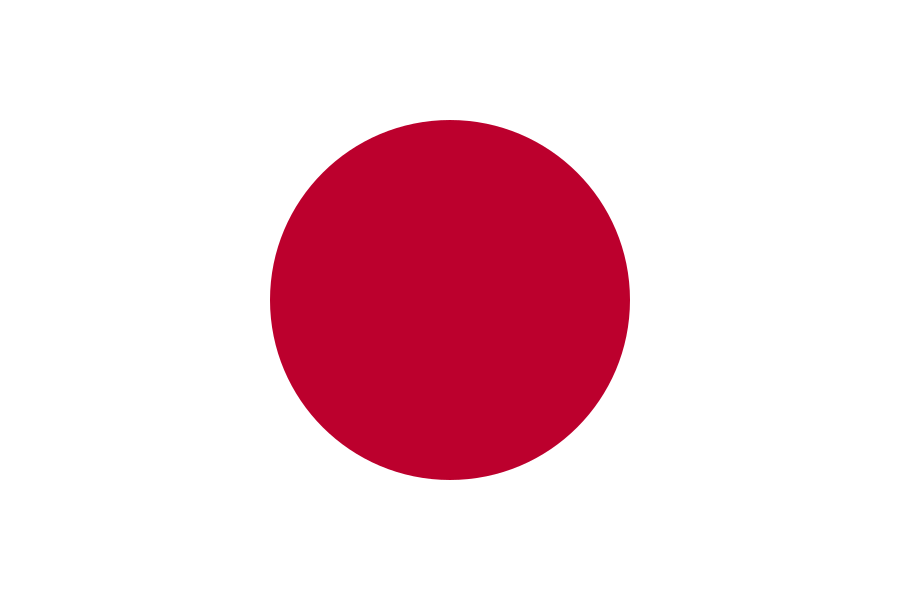
- Flag
-
- ISO code
- JP
- Population
- 125,800,000
- Currency
- JPY
- Timezone
- Asia/Tokyo
- Dial code
- +81
A Gazetteer for Travellers Heading to Japan
Japan demands that you plan around its train network, not the other way around. This japan travel guide exists to explain the fundamental tension at the heart of any trip there: the rail system is so efficient it shapes your entire itinerary, the cash economy persists inside a high tech society, and two short seasonal windows concentrate the entire country's travel demand into chaos. Understand those three forces and you understand what Japan actually asks of a visitor. Misunderstand them and you will spend your trip in transit, out of cash, or locked out of a room you booked too late.
- Minimum recommended stay: 10 days. Any less burns cash on a rail pass and skips past places you will not have time to understand.
- Peak travel windows: Late March to early April (cherry blossom) and November (autumn foliage). Book months ahead or do not go.
- Avoid if possible: Golden Week (late April to early May), New Year (Dec 29 to Jan 3), and the rainy season (June to mid-July).
- Japan Rail Pass price hike impact: Since the 2023 increase the pass rarely saves money unless you cover huge distances daily. Do the math before buying.
- Cash reliance: Cash is still required at many rural restaurants, temples, smaller ryokan, and local buses. Carry enough.
- Shinkansen top speed: 320 km/h on the Tōhoku Shinkansen (E5 series). Tokyo to Osaka is 2 hours 22 minutes by Nozomi service.
- Entry visa: Visa waiver for 71 countries as of 2025. Length of stay granted on arrival varies by nationality. Check your government's travel advisory for the current list.
First Trip to Japan Advice
Plan for 10 days at minimum. Any less and you are spending a significant portion of your budget on a Japan Rail Pass to rush through places you will not remember. The single most common mistake first time visitors make is trying to see Tokyo, Kyoto, and Osaka in a rushed 7 day trip while also buying a 7 day Japan Rail Pass that does not pay off. That creates a blur of transit stations and a checklist of sights without leaving time for the unplanned wandering where Japan's magic actually lives.
The language barrier is more formidable than most visitors expect. English signage exists in major stations and tourist hubs, but it disappears quickly in residential neighbourhoods, rural bus stops, and smaller restaurants. Download Google Maps before you arrive and keep it running; you will need it for navigating train platforms and timetables. Free public Wi Fi is unreliable and often requires a tedious sign up portal. Renting a pocket Wi Fi device or buying a data only eSIM before arrival is standard practice. A backup power bank is non negotiable. Maps drains battery fast.
Japan is a land of meticulous order and deep contrasts, where ancient temples sit in the shadow of neon skyscrapers. The sheer density of rules, both spoken and unspoken, can be exhausting even as the country's safety and efficiency feel like a relief. Eating while walking is widely considered impolite. Standing to eat at food stalls is acceptable. Trash cans are virtually non existent in public; you carry your rubbish for hours until you find a convenience store or return to your accommodation. Tipping is not practiced; service charge is included in bills at mid range and high end restaurants.
Visas And Entry Requirements
Short term tourism is visa free for 71 countries as of 2025, but the length of stay granted on arrival varies by nationality. You may receive 15, 30, or 90 days. All visitors must submit a Customs Declaration form, either paper or via the Visit Japan Web digital service. Duty free allowances are 3 bottles of alcohol and 400 cigarettes. Be careful with medication: stimulants including some ADHD medications and decongestants containing pseudoephedrine above a threshold are prohibited. Import of certain prescription drugs requires a Yunyu Kakunin sho certificate from a Regional Bureau of Health and Welfare, and the application takes several business days.

Japan Rail Network Overview
The dominant mode of getting around is the nationwide rail network operated by the JR Group, which comprises six passenger companies and one freight operator. The Shinkansen bullet train network spans approximately 3,000 km. Tokyo to Osaka takes 2 hours 22 minutes on the fastest Nozomi service. Tokyo to Hakata takes 4 hours 47 minutes on the Nozomi. Tokyo to Sapporo takes roughly 8 hours via bullet train to Shin Hakodate Hokuto plus a limited express; a through Shinkansen to Sapporo is expected after 2030.
The biggest trip up for visitors is that the Japan Rail Pass does not work on the fastest Nozomi or Mizuho services. You can still ride the high speed network using the pass, but only on the Hikari, Sakura, and Kodama services, which make more stops and take longer. Since the 2023 price hike the rail pass rarely saves money unless you are covering huge distances daily. Calculate your actual fares before buying.
For local transit, you need a physical IC card. The two major options are Suica and Pasmo. These ten major cards are mutually usable for transit and e money across the country. The cards work on subway, bus, and most private railway lines as well as JR local trains. They also double as e money for convenience stores, vending machines, and some eateries. The pass does not replace the IC card; you need both for a complete trip.
What The Rail Pass Actually Covers
Eligibility is limited to foreign tourists entering under Temporary Visitor status. Validity runs for consecutive 7, 14, or 21 days, with Ordinary and Green Car variants. You purchase online via the official site or through authorized overseas agents and receive an exchange voucher to activate in Japan. The pass covers most JR trains including the bullet train (except Nozomi and Mizuho), limited express, rapid, and local services. It does not cover the Tokyo Metro, the Toei Subway, or most private railways like the Kintetsu line from Kyoto to Nara. For day trips from Tokyo to Kamakura, the JR Yokosuka line takes about one hour. For Nikko, the Tobu limited express takes 1 hour 50 minutes but is not covered by the JR Pass.
| Region | Character | Minimum Duration | Best For |
|---|---|---|---|
| Hokkaido | Frontier wilderness, powder snow, dairy, lavender | 5-7 days for a single base; 10-14 days for a circuit | Skiers, hikers, summer wildflower enthusiasts |
| Tohoku | Deep snow country, rugged coastlines, ancient festivals | 5-7 days for highlights; 10+ days for a full traverse | Onsen lovers, festival chasers, remote nature seekers |
| Kanto (Tokyo area) | Megacity sprawl, day trip mountains, culinary density | 4-6 days for Tokyo plus day trips | First time visitors, pop culture fans, foodies |
| Kansai (Osaka/Kyoto) | Historical heart, mercantile food culture, temple fatigue risk | 5-7 days for Kyoto Nara Osaka basics; 10+ days with Koyasan and Himeji | History buffs, food obsessives, garden lovers |
| Chubu (Japanese Alps) | Mountain hiking, thatched roof villages, onsen monkeys | 5-7 days for one coast plus alpine crossing; 10-14 days for both coasts | Hikers, alpine scenery seekers, traditional village fans |
| Chugoku | Quiet shrines, Hiroshima's gravity, art islands | 4-5 days for Hiroshima Miyajima Okayama; 7-10 days including San'in coast | History travellers, art enthusiasts, solitude seekers |
| Shikoku | 88 temple pilgrimage, river valleys, rural escape | 5-7 days for highlights; 14+ days for full pilgrimage | Pilgrims, cyclists, rural Japan explorers |
| Kyushu | Active volcanoes, hot springs, laid back cities, ramen diversity | 5-7 days for northern circuit; 10-14 days including Yakushima | Onsen addicts, volcano chasers, ramen tourists |
| Okinawa | Subtropical islands, distinct Ryukyu culture, American bases | 4-5 days for main island; 7-10 days with outer islands | Beach lovers, divers, culture enthusiasts |
Japan Itinerary Planning
The rail network dictates your itinerary shape. Japan is four main islands Honshu, Hokkaido, Kyushu, and Shikoku divided into 47 prefectures. The standard first time route runs Tokyo to Kyoto to Osaka, which fits inside a single Honshu corridor and works well with a 7 day rail pass if you also add a day trip to Hiroshima or Himeji. But the pass math changes if you stay in one city for four days.
The most underestimated factor by first time visitors is transit time between attractions in rural and mountainous areas, where one bus or train per hour is common. The second most underestimated factor is the physical scale of Kyoto. Major sights spread across multiple districts with bus journeys of 30 to 60 minutes between clusters. You cannot see Kinkaku ji, Fushimi Inari, and Arashiyama in one morning. The third most underestimated factor is seasonal accommodation scarcity. During cherry blossom season, autumn foliage season, and New Year, bookings fill months ahead. If you are planning a first trip to Japan during these peaks, reserve your rooms before you buy your flight.
Regional Strategies
For Kansai, budget 5 to 7 days for Kyoto, Nara, and Osaka basics. Add 10 or more days if you want Koyasan and Himeji. For the Japanese Alps in Chubu, you need 5 to 7 days for one coast plus an alpine crossing, or 10 to 14 days for both coasts. For Kyushu, 5 to 7 days covers the northern circuit; 10 to 14 days lets you include Yakushima. For Hokkaido, plan 5 to 7 days for a single base like Sapporo plus day trips to Otaru and Noboribetsu, or 10 to 14 days for a full circuit taking in Furano, Hakodate, and Shiretoko. Shikoku requires a minimum of 5 to 7 days for highlights, but the full 88 temple pilgrimage takes 14 or more days and a car or bus is essential for the interior. Okinawa needs 4 to 5 days for the main island and 7 to 10 days for outer island hopping; a car rental is near essential.
Japan Travel Tips
Cash is still king. Despite the proliferation of QR code payments like PayPay, LINE Pay, and Rakuten Pay in urban retail since 2020, many small restaurants, rural accommodations, temples, and local bus services still require cash. ATMs that accept foreign cards are available at 7 Eleven stores nationwide via Seven Bank, at Japan Post Bank ATMs, and at some Family Mart and Lawson locations. Do not rely on your hotel to provide cashback. Withdraw enough at the airport because rural ATMs are less reliable.
Tattoos ban you from most public onsen and gyms unless you book a private bath or use cover up patches. If you have visible ink and want the onsen experience, reserve a room with a private bath or stay at a ryokan that explicitly allows tattoos. Some facilities provide covering stickers; ask at reception before entering.
Restaurant queues can exceed an hour for a famous bowl of ramen even in a nondescript alleyway. If you see a line outside a 12 seat shop at 10:45 AM, decide whether that bowl is worth 60 minutes of your trip. Often it is not. The famous options are not always the best ones. A ramen shop with no queue in a residential neighbourhood of Osaka or Fukuoka can serve a bowl that beats the 2 hour wait lists.
The rainy season runs June to mid July across Honshu, Kyushu, and Shikoku. It is not a total washout but brings oppressive humidity. Hokkaido is largely unaffected. Typhoon season peaks from July to October, with the highest landfall probability in Kyushu, Shikoku, Okinawa, and southern Honshu. Winter snow is heavy on the Japan Sea coast of Honshu and in Hokkaido from December through February, while the Pacific coast is largely dry and sunny. Pack for the region, not for the country.
Day Trips That Work
Nara from Kyoto takes 45 minutes by Kintetsu express. See the massive bronze Buddha at Todai ji and the bowing deer. Himeji from Kyoto or Osaka takes 55 minutes by bullet train. Japan's finest surviving feudal castle requires no advance booking. Miyajima from Hiroshima takes 25 minutes by JR train plus a 10 minute ferry. Time the ferry to catch Itsukushima Shrine's floating torii at high tide. Kamakura from Tokyo takes one hour by JR Yokosuka line. The Great Buddha and seaside temples are worth half a day. Nikko from Tokyo takes 1 hour 50 minutes by Tobu limited express. The lavishly carved Tokugawa mausoleum at Toshogu sits in a cedar forest and justifies an early start.
Who Japan Suits and Who Should Skip it
Japan suits first time Asia visitors who value safety and cleanliness. It suits solo travellers who appreciate reliable infrastructure and personal space. It suits obsessive foodies willing to plan trips around regional specialities like Hiroshima style okonomiyaki, Hokkaido miso ramen, Osaka kushikatsu, Kyoto kaiseki, Nagasaki champon, Kobe beef, and Fukuoka Hakata ramen. It suits pop culture and design enthusiasts who want to see the real thing behind the exported image. It suits skiers and hikers chasing world class snow and trails, especially in Hokkaido and the Japanese Alps.
Japan is not for travellers on a tight budget who want a cheap, spontaneous Asian backpacking trip. Accommodation is expensive, rail passes cost hundreds of dollars, and food adds up. It is not for those who need loud, late night party scenes outside a few specific city blocks in Shinjuku, Shibuya, or Dotonbori. It is not for anyone who finds rigid schedules and limited seating on transit stressful. Japan rewards the planner. The spontaneous traveller will run out of cash, miss the last bus, or sleep at a capsule hotel that costs more than a hostel in Bangkok.
Common Questions
How much cash should I carry for a day in Japan?
Budget enough to cover small eateries, temple entry fees, and local buses if you are heading into rural areas. Countryside destinations demand more cash than Tokyo or Osaka because card acceptance is limited. A day in the city with moderate spending runs lower than a day trip into the mountains.
Can I use my credit card everywhere in Japan?
No. Major hotels, department stores, and chain restaurants accept cards. Many smaller restaurants, temple entrance fees, rural accommodations, and local buses do not. Contactless payments via QR codes like PayPay are common in urban retail but require a Japanese bank account to load funds.
Is the Japan Rail Pass worth buying in 2026?
Probably not unless you cover huge distances daily. Since the 2023 price hike, a 7 day pass costs roughly the same as a round trip Tokyo to Osaka on a Nozomi service. Use a fare calculator on the official JR site to compare your planned route against the pass price before purchasing.
Do I need a visa to visit Japan?
Citizens of 71 countries and regions can enter visa free for short term tourism as of 2025. Length of stay granted on arrival varies from 15 to 90 days depending on nationality. Check your government's travel advisory for the current list because the policy is updated annually.
What should I do if I need medical help in Japan?
Call 119 for ambulance and fire emergencies or 110 for police. The Japan National Tourism Organization operates a 24 hour English language medical support hotline. Earthquake early warnings arrive via J Alert push notifications on compatible mobile devices.
Can I drive in Japan with my home country licence?
Only if you hold a 1949 Geneva Convention International Driving Permit. Licences from France, Germany, Switzerland, Belgium, Slovenia, Monaco, and Taiwan are recognized with an official Japanese translation. Holders of licences from countries party only to the 1968 Vienna Convention, including the UK, Australia, and New Zealand, must obtain a Japanese licence or use an alternative. Driving is on the left.
When is the absolute worst time to visit Japan?
Golden Week from late April to early May. The entire country travels domestically. Bullet trains become standing room only, hotels charge peak rates, and major attractions are packed. New Year from December 29 to January 3 is almost as bad because many independent restaurants and museums shut down entirely.
Read next
-
 Staying Connected in Japan eSIM Pocket Wi-Fi or Local SIM Compared
Free public Wi‑Fi in Japan is a trap. The networks that exist under names like Japan Connected free Wi‑Fi and city‑specific SSIDs require a sign‑up portal tha
Staying Connected in Japan eSIM Pocket Wi-Fi or Local SIM Compared
Free public Wi‑Fi in Japan is a trap. The networks that exist under names like Japan Connected free Wi‑Fi and city‑specific SSIDs require a sign‑up portal tha
-
 Best Time to Visit Japan What Each Season Actually Does
Cherry blossoms and autumn leaves draw the crowds for good reason, but Golden Week gridlock and New Year shutdowns can break an itinerary.
Best Time to Visit Japan What Each Season Actually Does
Cherry blossoms and autumn leaves draw the crowds for good reason, but Golden Week gridlock and New Year shutdowns can break an itinerary.
-
 Getting Around Japan Trains IC Cards and What the Map Oversells
The Japan Rail Pass is no longer an automatic buy. How to calculate if it pays off, which trains it excludes, and how IC cards actually work across regions.
Getting Around Japan Trains IC Cards and What the Map Oversells
The Japan Rail Pass is no longer an automatic buy. How to calculate if it pays off, which trains it excludes, and how IC cards actually work across regions.
-
 Japan Visa Rules and the Application Process Explained
Which passport holders can enter Japan visa-free, what landing permission means at the border, and how the full visa application works for everyone else.
Japan Visa Rules and the Application Process Explained
Which passport holders can enter Japan visa-free, what landing permission means at the border, and how the full visa application works for everyone else.
-
 Cash and Cards in Japan How You Will Actually Pay for Things
Japan runs on cash more than its robot reputation suggests. Where cards work, where they do not, and how to keep enough yen on hand without carrying too much.
Cash and Cards in Japan How You Will Actually Pay for Things
Japan runs on cash more than its robot reputation suggests. Where cards work, where they do not, and how to keep enough yen on hand without carrying too much.
-
 Is Japan Safe Reading the Advice Without Being Misled by It
Japan's crime rate is genuinely low, but earthquakes, typhoons, and the rare nuisance on a crowded train are the risks that actually matter.
Is Japan Safe Reading the Advice Without Being Misled by It
Japan's crime rate is genuinely low, but earthquakes, typhoons, and the rare nuisance on a crowded train are the risks that actually matter.
-
 A Ground-Level Logistics Guide to Independent Travel in China
First-time independent travel in China: what you need to know about visas, rail booking, eSIMs, mobile payments, and power adapters.
A Ground-Level Logistics Guide to Independent Travel in China
First-time independent travel in China: what you need to know about visas, rail booking, eSIMs, mobile payments, and power adapters.
-
 How Solo Travelers Stay Ahead of Flight Delays and Cancellations
How solo travelers can track inbound aircraft, claim rebooking rights, and adjust ground transport when flights go wrong — step by step.
How Solo Travelers Stay Ahead of Flight Delays and Cancellations
How solo travelers can track inbound aircraft, claim rebooking rights, and adjust ground transport when flights go wrong — step by step.
-
 Why Your eSIM Might Not Work Abroad and How to Check Before You Go
Buying an eSIM doesn't guarantee signal abroad. Learn why coverage fails by location and how to verify reach before you commit to a plan.
Why Your eSIM Might Not Work Abroad and How to Check Before You Go
Buying an eSIM doesn't guarantee signal abroad. Learn why coverage fails by location and how to verify reach before you commit to a plan.