A Gazetteer for Seeing Bulgaria Without a Package Tour
Bulgaria delivers raw authenticity from mountain villages to Black Sea dunes, best suited to independent road-trippers who value discovery over polish.
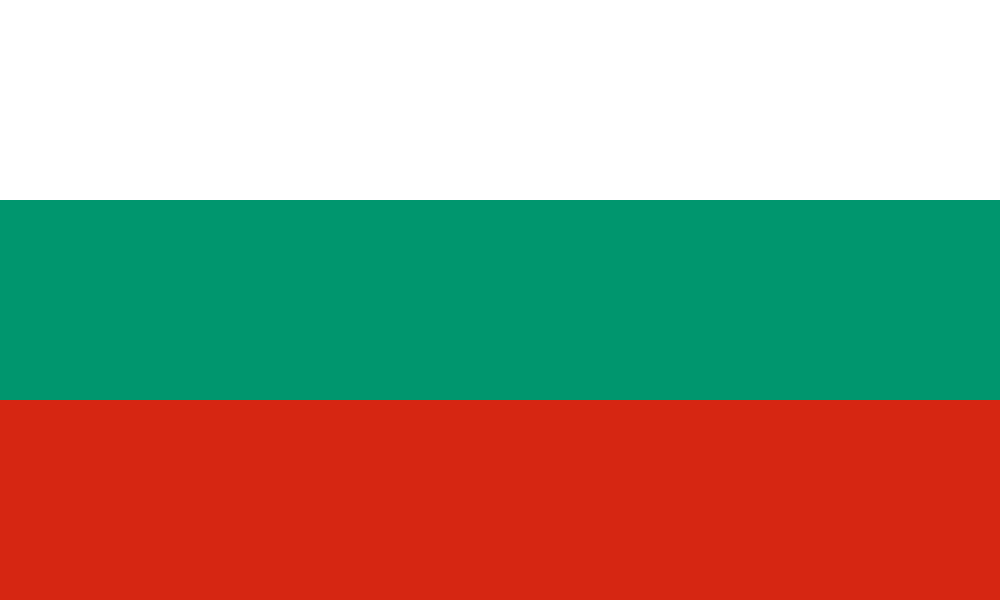
- Flag
-
- ISO code
- BG
- Population
- 7,000,039
- Currency
- BGN
- Dial code
- +359
A Gazetteer for Seeing Bulgaria Without a Package Tour
Independent travel Bulgaria is a test of patience and a reward for it. The country delivers raw, unpolished authenticity. Villages in the high ranges still operate at a slower rhythm. Black Sea beaches run from party strips to empty dunes, and Roman ruins sit unticketed in fields. Infrastructure is rougher than most visitors expect. Pavements are patchy. English is sporadic outside cities. The lingering post-communist aesthetic can feel bleak on a rainy Tuesday. If you are booking a package resort you do not need this. If you intend to drive, hike, and hunt for Thracian tombs on your own schedule, read the rest.
- Official name: Republic of Bulgaria
- Capital: Sofia
- Population: approx. 6,500,000 (2023 estimate, National Statistical Institute of Bulgaria)
- Area: 110,994 km²
- Land borders: Romania, Serbia, North Macedonia, Greece, Turkey
- Coastline: Black Sea, approx. 378 km
- EU membership: since 1 January 2007
- Schengen Area: full member from 1 January 2025 (air and sea from 31 March 2024)
- Currency: Bulgarian lev (BGN), pegged to the euro at 1 EUR = 1.95583 BGN
- Euro adoption target: 1 January 2026 (check the Bulgarian National Bank for confirmation)
- Official language: Bulgarian (Cyrillic script)
- Time zone: EET (UTC+2), EEST (UTC+3) from last Sunday March to last Sunday October
- International dialling code: +359
- Emergency number: 112 (police, fire, ambulance)
Why Bulgaria Works for Independent Travel Bulgaria
Bulgaria fits the traveller who enjoys discovery over curation. The question is what exactly you are signing up for. Below ground, Thracian beehive tombs hold painted domes from the fourth century BC. At grade, Roman theatres in Plovdiv still host performances. At altitude, Rila and Pirin deliver alpine scenery that rivals the Swiss Alps at a fraction of the price. A three-course meal with wine in a mountain lodge runs around 30 BGN. A lift pass for a day of hiking access in Pirin National Park costs nothing. The trails are free.
What It Costs
Balkan budget travel is real here. A private room in a guesthouse outside the peak season runs 40 to 60 BGN per night. A bus between Plovdiv and Burgas costs about 20 BGN. The catch: you need cash for most of it. Card terminals are absent in many village shops, guesthouses, and at roadside stalls. Carry Bulgarian lev in small denominations, 5, 10, and 20 BGN notes, because drivers and kiosk attendants rarely have change for a 50.
When the Equations Flip
The same factors that make Bulgaria cheap also create friction. Cyrillic-only road signs on rural routes make self-navigation harder than expected. Download offline maps with Cyrillic place names before you leave. GPS may route you onto unpaved tracks without warning. Pavement quality on village and highland roads deteriorates fast. A 50-kilometre drive on the map can take two hours on a two-lane road through every village, slowed by horse carts and stray dogs.

Getting Around Without a Tour
A Bulgaria road trip is the dominant mode for independent travel, and for good reason. The bus network uses private companies operating from separate stations within the same city. There is no national timetable, no central booking platform. Payment is cash to the driver or at a station kiosk. Online booking exists for very few routes. The real tripwire: bus timetables posted at stations are often aspirational. Confirm departure times by asking the driver or kiosk attendant directly on the day.
Driving
Car rental from Sofia, Burgas, or Varna airport gives you control. Major international agencies are present; local agencies offer lower base rates with varying insurance terms. You need an electronic vignette for all vehicles using the national road network outside urban areas. Buy it online or at a border kiosk before you set off. The motorway network is incomplete. The Hemus motorway (A2) linking Sofia to Varna has a gap in its central section as of 2026, which means a two-hour stretch on a single-carriageway road through the Balkan Range. Cross-country speed rarely exceeds 50 to 55 km/h outside the motorways. Plan your day around that number.
Rail
BDZ, the state railway operator, runs scenic services but they are rarely the fastest option. The quickest Sofia to Burgas service takes roughly 6.5 hours for about 400 kilometres. Rail is for travellers with time who enjoy the landscape, not for anyone on a tight schedule.
Air Access
Sofia Airport (SOF) has a metro line M1 to the city centre, 25 minutes, about 1.60 BGN. Burgas Airport (BOJ) uses bus 15 to Burgas South Bus Station, 30 minutes, about 1.50 BGN. Varna Airport (VAR) uses bus 409 to Varna centre, 20 minutes, about 1.50 BGN. Plovdiv Airport (PDV) has limited seasonal flights; a taxi to the centre takes 20 minutes. No airport train stations except Sofia.
| Range | Best hiking season | Key risk |
|---|---|---|
| Rila Mountains | Late June to mid-September (above 2,000 m) | Afternoon thunderstorms; snow possible any month above 2,000 m |
| Pirin National Park | Late June to mid-September | Limestone terrain; route finding requires GPS on longer routes |
| Rhodope Mountains | May to October | Stray dogs near trailheads; bear territory on remote routes |
| Balkan Range (Stara Planina) | May to October | Long ridge exposure; afternoon lightning in open passes |
Moving Through the Landscape
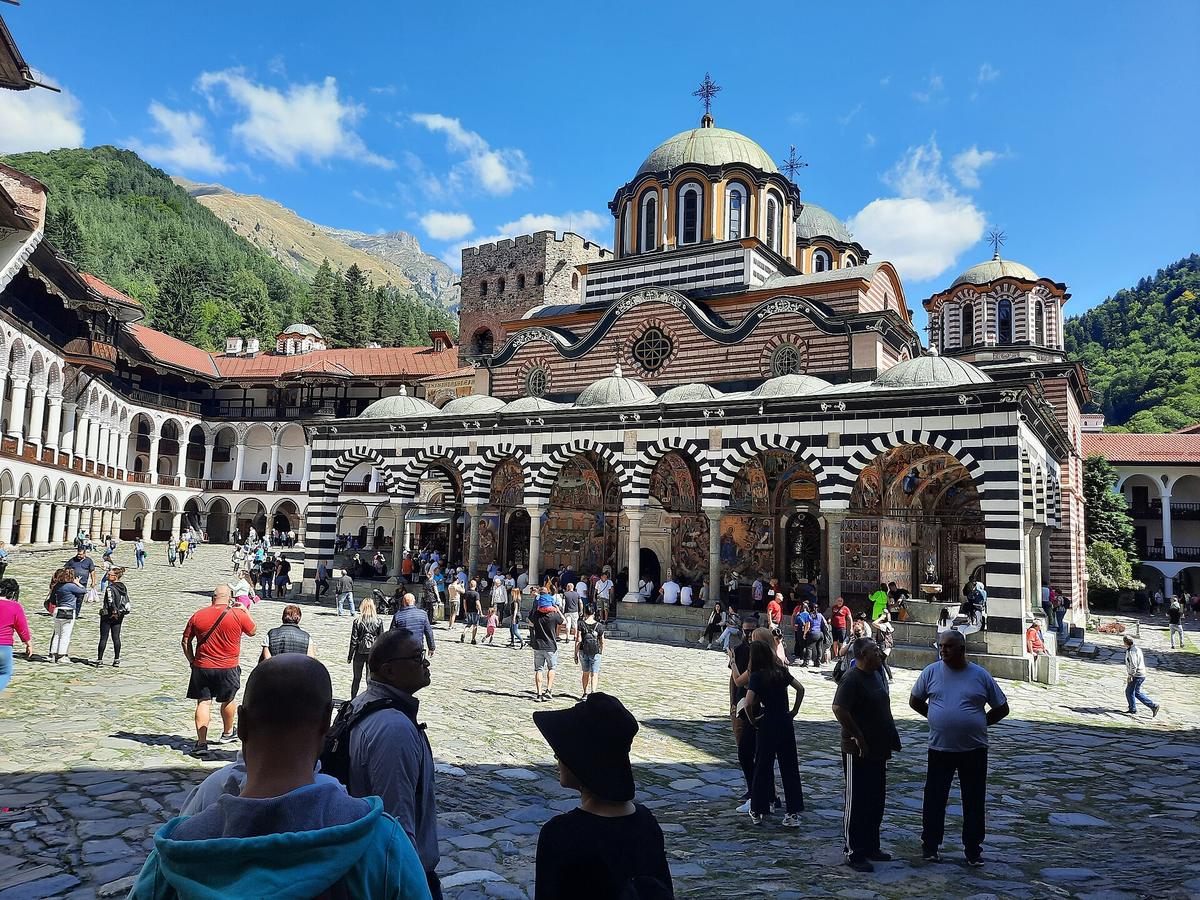
The rhythm of a Bulgaria road trip is set by the terrain. Leave Sofia in the morning heading south. For the first hour you cross the Sofia Field, the capital basin with Vitosha on the skyline. Then the road climbs into the Rila foothills. Rila Monastery sits in a high valley. Its vivid frescoes are a World Heritage Site. Arrive before 09:30 to have the courtyard mostly to yourself. After 11:00 the tour buses from Sofia arrive.
Continue south into the Pirin range. The Seven Rila Lakes are a glacial cirque accessible by chairlift then a 2- to 5-hour hike. The chairlift operates on a reduced schedule in late April and early May during the gap between ski and summer seasons. Many guesthouses close during that window. Avoid highland resorts in late April through early May for that reason. Orthodox Easter weekend causes nationwide accommodation shortages and restaurant closures across the whole country, not just the coast.
The Black Sea Coast
On the Black Sea coast, the polarisation is extreme. Purpose-built resort strips such as Sunny Beach and Golden Sands operate on a completely different price and service model from small coastal towns like Sozopol or Nessebar old town. Nessebar old town, an island peninsula with medieval churches, is overtouristed in July and August. Sozopol old town, 30 minutes south by bus from Burgas, is less crowded and retains more of its fishing-village character. The northern coast near Varna offers rocky cliffs, Cape Kaliakra, and Balchik Palace. The southern coast near Burgas has emptier beaches and access to Strandzha.
Heading Off-Season
Off-season travel changes the experience substantially. April, May, September, and October are the cultural sightseeing months. Plovdiv regularly exceeds 35 Celsius in July and August. In May or September you can walk Plovdiv Roman Theatre and the Kapana creative district without heatstroke. The Rhodope range in October has crisp air, golden beech forests, and very few other hikers. Some lifts shut in November. Some guesthouses in the Rila and Pirin ranges close entirely in the shoulder season. Check ahead. The trade-off for solitude is reduced services.
The winter inversion in lowland Sofia and the Thracian Plain can bring prolonged fog and poor air quality from December through February. If you come in winter, head for the high ground where the air is clear. Ski season runs December to April with the most reliable snow cover January through March. Bansko, Borovets, and Pamporovo are the three largest lift-served areas.

Who Should Come and Who Should Not
Bulgaria is for independent road trippers who enjoy discovery over curation. Budget-conscious travellers who want Alps-grade scenery at Balkan prices will find it. History buffs interested in Thracian, Roman, and Ottoman layers have four millennia of sites, from the Thracian Tomb of Kazanlak to the Banya Bashi Mosque in Sofia. Hikers and nature lovers seeking under-visited trails will find them across the Rila, Pirin, Rhodope, and Balkan ranges. Digital nomads wanting low-cost bases with decent Wi-Fi should look at Plovdiv and Bansko.
Bulgaria is not for luxury resort seekers expecting polished service and manicured grounds, outside a handful of five-star Black Sea enclaves. It is not for travellers who need smooth infrastructure, clear signage, and widespread English. It is not for people who equate safety with visible police presence. Rural Bulgaria can feel deserted. That unnerves some. If you need a concierge, a button to press, and a guarantee that the road is paved, choose a different country.
Common Questions
How many days do I need for Bulgaria?
Minimum 7 days. Less than a week forces you to choose between the ranges or the coast, and you will spend too much of it in transit on slow roads. A common mistake is trying to see the whole country in one week using public transport. Pick two regions maximum for a week.
Is Bulgaria safe for solo travellers?
Yes, with the usual urban precautions in Sofia. Rural Bulgaria can feel deserted, which unnerves some travellers. Stray dogs are common in rural areas and can be aggressive near hiking trailheads and remote monasteries. Carry a walking stick or stones. Violent crime against tourists is rare.
Do I need cash or will cards work?
Cash is essential outside Sofia and large cities. Many guesthouses, rural taverns, and bus drivers do not accept cards. Toilets in bus stations and rural restaurants are often squat-style and charge 0.50 to 1 BGN with an attendant. Carry coins.
What about phone and internet?
EU roaming works for EU SIMs. Local SIMs from A1, Vivacom, or Yettel cost about 10 to 15 BGN for 10+ GB. Buy at a high-street shop, not the airport, for better rates. 4G covers towns and main roads. Valleys in the high ranges and Strandzha have dead zones.
When should I absolutely avoid the coast?
Avoid the coast in the first week of July. That is the major Romanian school holiday exodus, causing heavy traffic at border crossings and resort check-ins. Also avoid highland resorts in late April to early May when lifts shut for maintenance between ski and summer seasons.
Can I wild camp in Bulgaria?
Technically prohibited outside registered campsites. Enforcement varies sharply by municipality and proximity to protected areas. Hikers commonly bivouac in the high ranges, but you take the risk of a fine. Stick to the alpine hut network in Pirin and Rila if you want legal overnight shelter.
How do I navigate Cyrillic road signs?
Download offline maps with Cyrillic place names before you leave. Road signs on minor routes often lack Latin transliteration. GPS coordinates work. The Madara Rider, Belogradchik Rocks, and Buzludzha Monument are all signposted but the signs are in Cyrillic only on the approach roads.
Read next
-
 Staying Connected in Bulgaria With eSIM, Local SIM, or Just Roaming
Compare eSIM convenience, local SIM value from Vivacom or A1, and EU roaming reliability for Bulgaria's mountain dead zones and coastal resorts.
Staying Connected in Bulgaria With eSIM, Local SIM, or Just Roaming
Compare eSIM convenience, local SIM value from Vivacom or A1, and EU roaming reliability for Bulgaria's mountain dead zones and coastal resorts.
-
 Best Time to Visit Bulgaria by Season and What Each One Actually Delivers
Bulgaria's seasons dictate more than weather: mountain lifts shut in May, the coast fills with Romanian families in July, and Easter closes everything.
Best Time to Visit Bulgaria by Season and What Each One Actually Delivers
Bulgaria's seasons dictate more than weather: mountain lifts shut in May, the coast fills with Romanian families in July, and Easter closes everything.
-
 Getting Around Bulgaria by Bus and Car When Timetables Are Aspirational
Bulgaria's bus network is a patchwork of private companies, cash fares, and aspirational timetables—here is how to make it work.
Getting Around Bulgaria by Bus and Car When Timetables Are Aspirational
Bulgaria's bus network is a patchwork of private companies, cash fares, and aspirational timetables—here is how to make it work.
-
 Bulgaria Visa Rules for Tourists and Digital Nomads Explained
Bulgaria sits at a Schengen crossroads: air and sea entry is now Schengen, land borders are not, and visa rules depend on your passport.
Bulgaria Visa Rules for Tourists and Digital Nomads Explained
Bulgaria sits at a Schengen crossroads: air and sea entry is now Schengen, land borders are not, and visa rules depend on your passport.
-
 Cash and Cards in Bulgaria What Actually Works at Taverns and Buses
The Bulgarian lev rules daily life: cards work in Sofia and big resorts, but rural buses, guesthouses, and station toilets demand coins.
Cash and Cards in Bulgaria What Actually Works at Taverns and Buses
The Bulgarian lev rules daily life: cards work in Sofia and big resorts, but rural buses, guesthouses, and station toilets demand coins.
-
 Safety in Bulgaria Reading the Advice Without Being Misled by It
Bulgaria is statistically safe, but stray dogs, empty rural roads, and slow mountain rescue create risks that generic advice misses.
Safety in Bulgaria Reading the Advice Without Being Misled by It
Bulgaria is statistically safe, but stray dogs, empty rural roads, and slow mountain rescue create risks that generic advice misses.
-
 A Ground-Level Logistics Guide to Independent Travel in China
First-time independent travel in China: what you need to know about visas, rail booking, eSIMs, mobile payments, and power adapters.
A Ground-Level Logistics Guide to Independent Travel in China
First-time independent travel in China: what you need to know about visas, rail booking, eSIMs, mobile payments, and power adapters.
-
 How Solo Travelers Stay Ahead of Flight Delays and Cancellations
How solo travelers can track inbound aircraft, claim rebooking rights, and adjust ground transport when flights go wrong — step by step.
How Solo Travelers Stay Ahead of Flight Delays and Cancellations
How solo travelers can track inbound aircraft, claim rebooking rights, and adjust ground transport when flights go wrong — step by step.
-
 Why Your eSIM Might Not Work Abroad and How to Check Before You Go
Buying an eSIM doesn't guarantee signal abroad. Learn why coverage fails by location and how to verify reach before you commit to a plan.
Why Your eSIM Might Not Work Abroad and How to Check Before You Go
Buying an eSIM doesn't guarantee signal abroad. Learn why coverage fails by location and how to verify reach before you commit to a plan.