Monastiraki, Athens: What It Is Like, Who It Suits, and What Is Within Walking Distance
Monastiraki, Athens: the flea-market district with rooftop bars and a metro nexus, what it feels like, and who it suits.
- Flag
-
- ISO code
- GR
- Currency
- EUR
- Timezone
- Europe/Athens
Monastiraki, Athens: What it is Like, Who it Suits, and What is Within Walking Distance
You land in Athens with a three day window and a list of sights that runs longer than your trip. You need a base that lets you hit the Acropolis, eat well at midnight, and get to the airport without a taxi. Monastiraki is that base. It is not the prettiest part of the city, and it makes no attempt to be. What it delivers is raw access: the metro hub that connects Line 1 and Line 3, a market square that has been a trading crossroads since the Ottoman era, and a rooftop bar scene that puts the floodlit Parthenon directly in your line of sight while you drink a beer. You stay here for speed, not tranquillity.
Monastiraki is the commercial hinge between Plaka and Psyrri, between the ancient Agora and the retail crush of Ermou. It is louder than Plaka, more tourist dense than Thissio, and less formal than Syntagma. The central platform is Monastiraki Square, a paved bowl framed by the neoclassical metro station facade, the domed Tzistarakis Mosque, and the Pantanassa Church. From that square, lanes radiate in every direction. Every direction leads somewhere worth your time within a ten minute walk.
Monastiraki Flea Market
How To Work The Sunday Market
Monastiraki flea market, known locally as Yousourum, is the district's oldest commercial engine. It operates daily, but Sunday is the event: stalls spill out from Ifestou Street and Avissynias Square into every available gap, and the walkways fill with serious collectors, cruise ship day trippers, and locals picking through vinyl crates and military surplus. The goods range from genuine antique furniture at Avissynias Square to racks of mass produced souvenir t shirts on Ifestou. You need to pick your lane. The second hand clothing stalls reward patience and a willingness to dig. The coin and medal tables are honest but priced for tourists. The mass produced leather bags and evil eye pendants lining Adrianou Street are identical to what you will find in Plaka, often cheaper by a couple of euros. Cash is standard here. Card acceptance is patchy across the stalls.
Prices, Pickpockets And The Haggle
The pickpocket risk is real, concentrated in the Sunday crowd around the metro entrance and the narrowest part of Ifestou. Keep your phone in a front pocket and your bag zipped. Do not stop in the middle of a lane to negotiate a price; step to the side, or count on getting jostled. The vendors expect haggle, especially on second hand goods, but not on the cheap souvenir rows. Offer half on furniture and large items, settle at sixty to seventy percent. On the vinyl and militaria tables, the price is usually the price.
Monastiraki Neighbourhood
The Ruins At Your Feet
Monastiraki is not a residential enclave. It is a transit and commerce zone that happens to sit on top of some of the most significant ruins in the western world. The Ancient Agora is a two minute walk from the square. Hadrian's Library is directly across Adrianou, visible from the street. The Roman Agora is a four minute walk east, tucked behind Plaka's first row of restaurants. You do not need a bus or a metro to reach any of these. Buy the combined ticket at the Ancient Agora entrance, which also covers the Acropolis, and you save queue time at the Parthenon the next day.
Street Smarts And Surfaces
The street layout is simple. Adrianou runs east west, connecting Monastiraki to Thissio and Plaka. Ifestou runs north south through the flea market core. Ermou and Mitropoleos run east to Syntagma. Athinas runs north to Omonia. The pedestrian zones are extensive but interrupted by motorbike delivery traffic and café tables that push onto the paving. Sidewalks are narrow, broken in places, and the marble slabs become dangerous after rain. Walk with your eyes down in the first block until you get used to the surface. The noise level is high, and the heat radiating from the stone makes midday a bad time to browse. Early morning, between 08:00 and 10:00, the market lanes are quiet enough to move freely and the light is better for photographs.
Monastiraki Rooftop Bars
Buy The View, Not The Cocktail
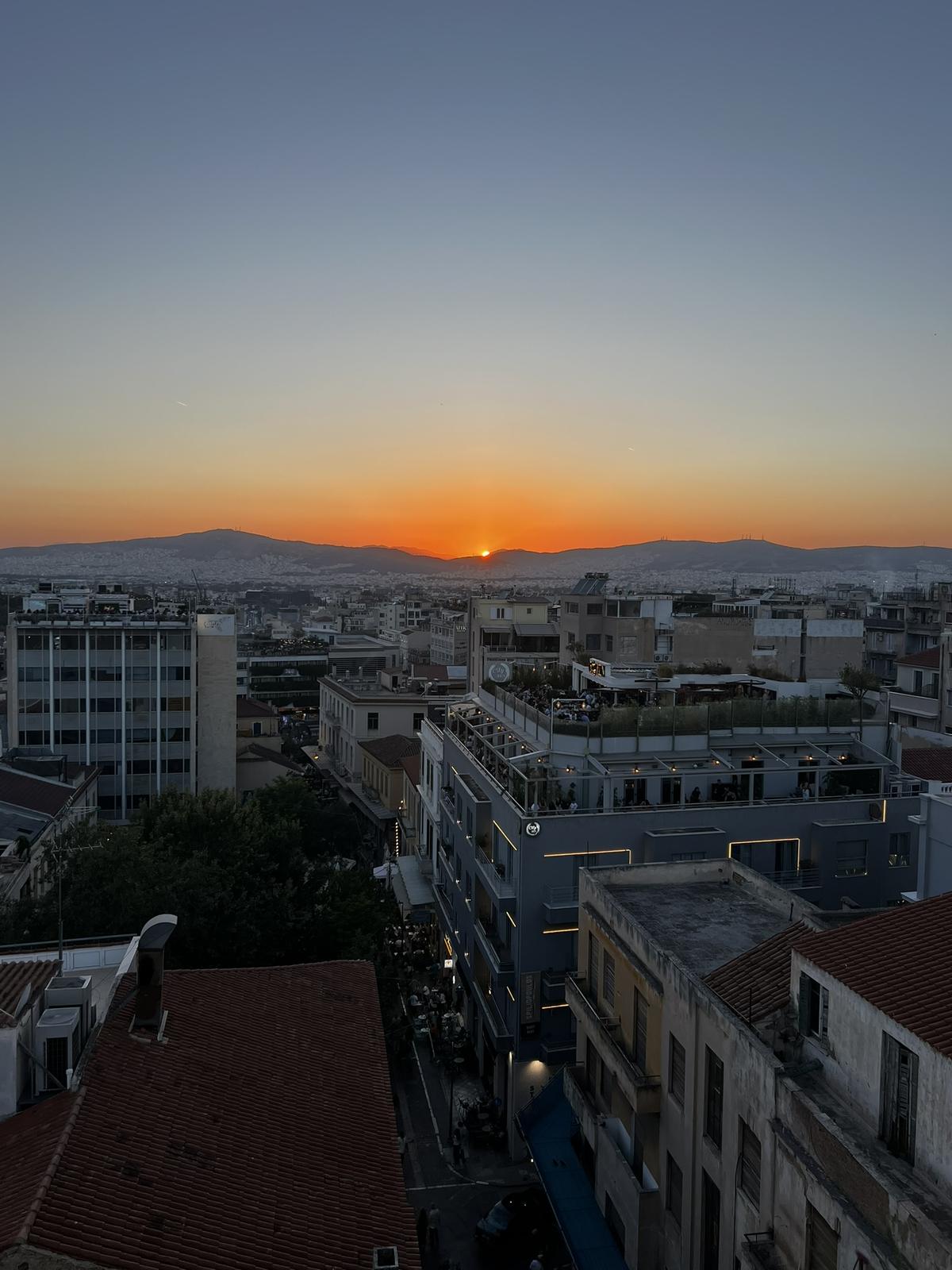
Monastiraki rooftop bars are the district's evening currency. The concentration is highest around Monastiraki Square and Mitropoleos Street, where buildings with south facing terraces capture the Acropolis view. You are paying for the angle, not the cocktail. The drinks are average and marked up, but the sight of the Parthenon lit against a dark blue sky while traffic hums below is the kind of payoff that justifies the price of a ten euro gin and tonic.
How To Get The Best Rail Table
A few rules. Book a table on the rail, not the interior row. Aim for a seat that faces southwest, not south east; the south east terraces catch the floodlights from the side rather than full on. Arrive around 19:30 in summer, 18:00 in winter, to watch the transition from daylight to illumination. The street noise from the square reaches the top floors, so do not expect a quiet evening. If you want a subdued drink with the same view, walk five minutes west along Adrianou into Thissio, where the cafés on Apostolou Pavlou are pedestrian only and the crowds thin out. But the energy you get from Monastiraki's bar scene, the mix of tourists and locals eating late meze in Psyrri, is specific to this corner of Athens and worth leaning into for at least one night.
Where to Stay in Monastiraki
Choose Your Noise Level
Where to stay in Monastiraki depends on your tolerance for noise and your budget for a room with a view. The hotel density is high, consisting mostly of small and mid size properties and short stay rentals. Large chain hotels are scarce; the big names cluster in Syntagma. You trade the chain's soundproofing and gym for direct access to the metro and a five minute walk to the Agora.
If you book a room facing Monastiraki Square or Mitropoleos, street and bar noise will run past midnight. That is fine if you are out until last call anyway, but if you plan to sleep before 01:00, request a courtyard room or a property on the eastern end of Adrianou, where the foot traffic drops off sharply after 22:00. Properties on Ifestou are the loudest during market hours and quietest after dark. Hotels on the Psyrri edge, near Ermou and Miaouli, sit in the boundary zone where the bar crowd filters through until 03:00 on weekends. The trade off is a short walk to the best late night meze tavernas.
Practical Booking Notes
Air conditioning is standard in mid range and above, but check before booking a budget room or an apartment. Heating is standard in winter. You want a property on the third floor or above to get above the street noise and the motorbike fumes. The municipal accommodation tax adds a few euros per night, and the rate changes annually, so confirm it at booking rather than at checkout.
Walking Distance from Monastiraki Square
The Core Walking List
One of the strongest arguments for basing yourself in Monastiraki is what you can reach without public transport. The list covers the major ancient sites, two neighbourhoods, the main shopping street, and the Acropolis entrance.
- Ancient Agora: Two minutes west through the pedestrian lane from the square.
- Roman Agora and Tower of the Winds: Four minutes east on Pelopida Street.
- Hadrian's Library: One minute north across Adrianou.
- Plaka: Directly east and southeast via Adrianou and the side lanes, five to ten minutes to the centre of the district.
- Psyrri: North of Ermou, five minutes walk from the square via Miaouli.
- Syntagma Square: Ten minutes east along Ermou, 700 metres of pedestrian retail.
- Thissio: Ten minutes west along Adrianou, past the Ancient Agora fence.
- Acropolis south slope entrance: Fifteen minutes via Dionysiou Areopagitou, the pedestrian street that wraps around the hill, about 800 metres from the square.
- Ermou Street: You are already on it; the shopping axis runs from Monastiraki to Syntagma.
Timing The Acropolis Walk
The walk to the Acropolis entrance is uphill on the last block. Do it in the morning before 08:30 or after 17:00 in summer to avoid the heat and the queue. The combined ticket you bought at the Ancient Agora gets you in without lining up again.


How Monastiraki Connects You to the Rest of Athens
The Two Line Advantage
Monastiraki metro station sits on two lines: Line 1, the green line, running north to south from Kifissia to Piraeus, and Line 3, the blue line, running from the airport through the centre to the western suburbs. This intersection makes Monastiraki the most efficient single transfer point in the city. You can reach the airport in 40 minutes without changing trains, Piraeus in 20 minutes for ferry departures, Syntagma in one stop, Omonia in one stop, and Kerameikos in one stop. The metro runs from about 05:30 to 00:30 on weeknights, later on weekends. After that, you are looking at a taxi from Syntagma or Athinas Street, which is a short walk from the square. Taxi availability is good at the staging points on Ermou and Athinas.
Skip The Metro To The Acropolis
The only catch is the Acropolis stop on Line 2. To reach it from Monastiraki, you take Line 3 one stop to Syntagma and transfer to Line 2 one stop to Akropoli. The entire journey takes under ten minutes, but the transfer requires walking through a long underground passage. You are better off walking from Monastiraki to the south slope entrance in the time it takes to execute the transfer. The same applies to the Acropolis Museum: walk through Plaka or along Dionysiou Areopagitou, do not ride the metro.
| Route | Line | Time | Notes |
|---|---|---|---|
| Monastiraki to Athens Airport | Line 3 | 40 min | Direct, no transfer |
| Monastiraki to Piraeus | Line 1 | 20 min | Direct, for ferries |
| Monastiraki to Syntagma | Line 3 | 3 min | One stop east |
| Monastiraki to Omonia | Line 1 | 4 min | One stop north |
| Monastiraki to Kerameikos | Line 3 | 4 min | One stop west |
| Monastiraki to Acropolis | Walk | 15 min | Via Dionysiou Areopagitou, 800 m |
Who Monastiraki Suits and Who Should Skip it
Who Should Stay Here
Monastiraki suits short stay visitors who prioritise central access, nightlife, and budget to mid range hotels over quiet or residential character. It suits solo travellers comfortable with urban grit, food driven visitors on a mid range budget who plan to eat late in Psyrri, and history focused travellers who want depth over polish. The raw, lived in energy of the flea market and the convenience of the metro hub outweigh the noise and the crowds for these readers.
Who Should Look Elsewhere
Monastiraki does not suit travellers seeking a relaxing, green, or pristine European capital. It frustrates visitors with significant mobility limitations: the metro station has lifts, but the market lanes are cobbled, stepped, and crowded. Families with strollers will struggle on Ifestou and Adrianou. Anyone who dislikes heat, crowds, smoking adjacent spaces, or visible urban decay should base themselves in Koukaki or Thissio instead. Mid July through August is brutal; the heat exceeds 38°C, many local vendors close for holidays, and the square feels emptied of Athenians but packed with overheated tourists. April through June and September through October are the right months to be here.
The One Thing You Should Do Next
Arrive at Monastiraki metro station and take the stairs toward the square. Stand at the top long enough to orient yourself: the mosque is behind you, the church is to your left, the Ancient Agora is straight ahead through the pedestrian lane, and the flea market runs north up Ifestou. Buy a combined ticket from the Agora ticket booth, book a table at a rooftop bar for your last evening, and walk to the Acropolis south entrance the next morning before 08:30. Everything else falls into place from that axis.
Other areas in Athens
Common Questions
Is Monastiraki safe at night?
The area around Monastiraki Square, Adrianou, and the pedestrian lanes toward Plaka and Syntagma is busy until late and safe. Pickpocket risk is higher during daytime market hours than at night. The edge toward Psyrri is safe but rowdy on weekend nights. Avoid poorly lit side streets north of Ermou after midnight.
What is the best day to visit the flea market?
Sunday. The market expands into Avissynias Square and the side streets, and the antiques and furniture selection is at its largest. The crowd is also at its largest, so arrive before 10:00 to browse without fighting the density. The market operates daily but is noticeably smaller Monday through Wednesday.
How do I get from Monastiraki to the Acropolis without the metro?
Walk. Exit Monastiraki Square onto Areos Street, which becomes Dionysiou Areopagitou after crossing the pedestrian lane. The walk is 800 metres, mostly flat until the last 200 metres uphill, and takes about 15 minutes. This puts you at the south slope entrance, which is less crowded than the main west entrance.
Which rooftop bar in Monastiraki has the best Acropolis view?
The bars on Mitropoleos Street and the western edge of Monastiraki Square offer the most direct sightline. A for Athens and 360 Cocktail Bar are the best known. Book a rail table on the south side 30 minutes before sunset. Expect to pay 10 to 15 euros per drink.
Can I walk from Monastiraki to Syntagma with luggage?
Yes, along Ermou Street. The distance is 700 metres on a flat, pedestrianised street. The surface is smoother than the market lanes, though it is crowded midday. It is the recommended route if you are travelling between the two metro stations rather than riding one stop.
Read next
-
 Athens Hotels by Price Band and What Each Band Actually Gets You
Athens hotel prices rise sharply with Acropolis views and rooftop access. Here's what each price band actually delivers.
-
 Where to Stay in Athens and What Each District Costs You
The district you choose in Athens changes everything about your trip. Compare Plaka, Monastiraki, Koukaki, and the rest by trade-off.
-
 Athens Flights, Flying Into ATH and Getting Out of the Airport
Flying into Athens: what to expect at ATH, and how to get from the airport to Syntagma, Monastiraki, or Piraeus.
-
 Athens Things to Do Ordered by Whether They Are Worth the Time
Not every Athens sight deserves your limited hours. This guide ranks what to do by the time it takes and what it gives back.
-
 Best Time to Visit Athens and What Each Season Does to It
Athens has two comfortable shoulder seasons, a brutal August, and winter free-entry Sundays. Here's what each season does to the city.
-
 Getting Around Athens Without Wasting Half Your Trip
Athens has a good metro but late nights, marble streets, and taxi habits can trip you up. Here's how to get around without friction.
-
 Koukaki
, Athens: the quiet residential district near the Acropolis Museum, what it feels like, who it suits, and what is nearby.
-
 Plaka
Plaka, Athens: the neoclassical district beneath the Acropolis, what it feels like, who it suits, and what is within walking distance.
-
 Kolonaki
, Athens: the upscale gallery and designer-shopping district on steep streets, what it feels like, and who it suits.