How to Budget a Trip Based on Purchasing Power, Not Just Exchange Rates
Exchange rates tell only half the story. See how purchasing power shapes your real travel budget across Southeast Asia, Eastern Europe, and Latin America.
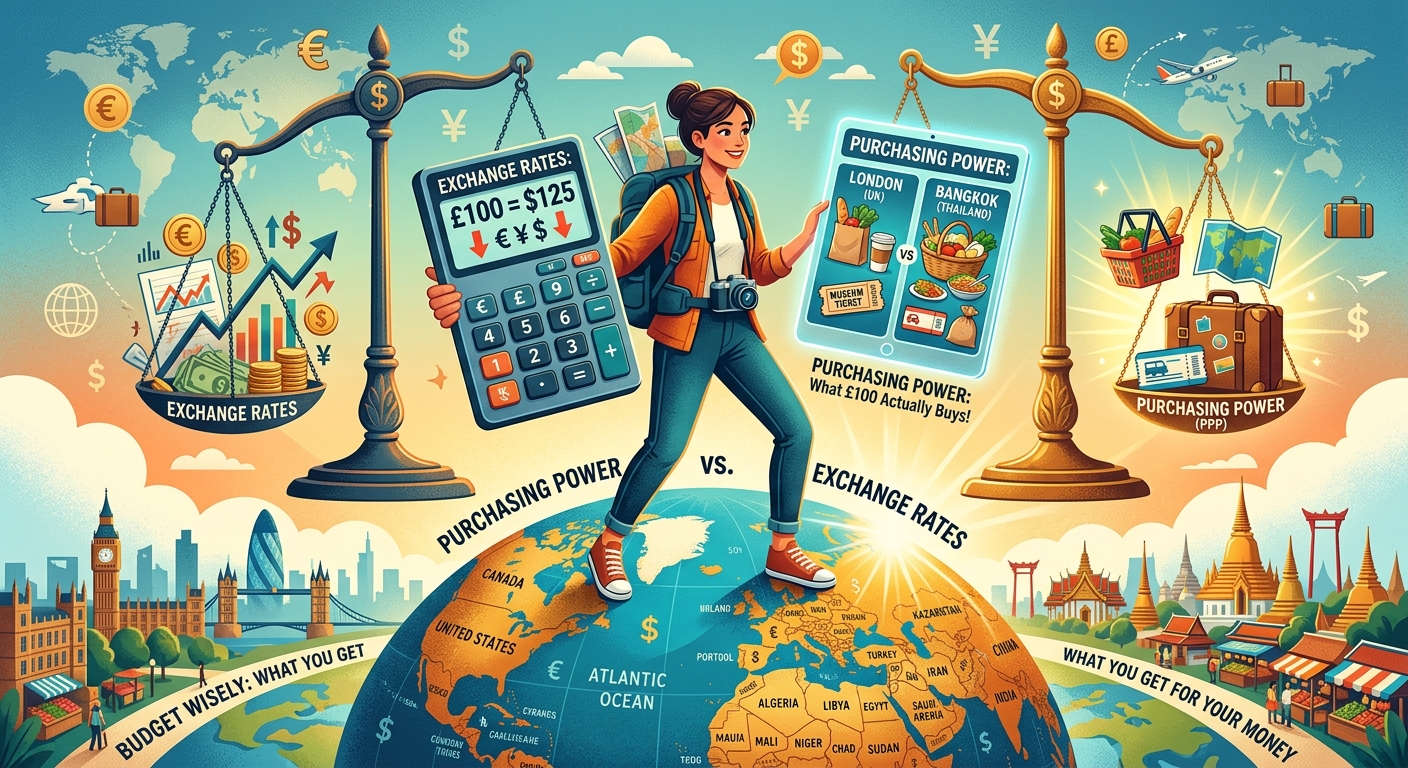
Checking the exchange rate feels like doing your homework. You see that the dollar buys 35 Thai baht, or that your euros stretch noticeably further in Albania than in France, and you feel prepared. The problem is that a currency conversion ratio tells you almost nothing about your actual spending experience on the ground. It measures the relationship between two currencies, not the relationship between local prices and what you normally earn at home. Those are very different questions, and confusing them is one of the most common budget mistakes independent travelers make.
Three Things to Settle Before You Set a Daily Budget
- Exchange rates convert currency only; they do not tell you how affordable a destination is relative to your income at home.
- The same $50-a-day budget produces very different comfort levels depending on where you earn your money.
- Running your home-country wages through a purchasing power tool before booking gives you a more honest starting point than any currency conversion app.
Why the Exchange Rate Number Misleads More Than It Helps
Consider two travelers flying to Chiang Mai, Thailand. One earns in US dollars in Seattle. The other earns in Philippine pesos in Manila. Both read that the Thai baht is "cheap" against the dollar. Both arrive planning to spend $50 in local currency value per day.
The Seattle traveler feels like they are living well for relatively little. The Manila traveler is spending, in relative terms, a significant chunk of what they would earn back home. Their experience of that same $50 is completely different, even though the baht notes in their hands are identical.
This gap is precisely what exchange rates miss. They do not account for income levels, local price structures, or what comparable goods cost in your home economy. A full meal in Bangkok is cheap compared to New York. It is much less cheap compared to a local salary in Cebu.
Purchasing Power: What It Actually Measures
Purchasing power parity, the concept behind all of this, compares what a given amount of money can actually buy across different economies. It uses a standardized basket of goods and services to strip away currency noise and reveal real-world affordability. The World Bank tracks these figures across more than 170 countries through its global price benchmarks program, updated regularly and freely available to the public.
For travelers, the practical version is simpler. You want to know: does my income put me ahead of or behind the local economy at this destination? That single question shapes everything from your accommodation tier to how many paid attractions you can realistically visit per week.
Southeast Asia: Where the Income Gap Creates Real Budget Cushion
For someone earning in euros, British pounds, Australian dollars, or US dollars, Southeast Asia is one of the most dramatic illustrations of purchasing power at work.
In Vietnam, a solid meal at a proper local restaurant runs between $2 and $4. A clean guesthouse room in a mid-tier city costs $15 to $25 per night. A motorbike taxi across town is under $1. A traveler from Germany on a $50-a-day budget is living comfortably, with room left over for entry fees, longer transport legs, and the occasional accommodation upgrade.
Now run the same scenario for a traveler from Indonesia. The Indonesian rupiah and Vietnamese dong sit in similar regional economic bands. That $50 equivalent is not a daily travel budget anymore. It is a meaningful portion of what many Indonesian professionals take home in a week. The relative sacrifice is entirely different.
This is not a criticism of travel from mid-income countries. Plenty of travelers from the Philippines, Indonesia, or Vietnam visit neighboring destinations and manage their budgets thoughtfully. The point is that the "Southeast Asia is cheap" headline assumes a specific income background. It only holds when your income is anchored to a high-purchasing-power home economy.
Eastern Europe: The Region That Recalibrates the Math
Eastern Europe is attracting more independent travelers, and the reasons are legitimate. Countries like Albania, Georgia, North Macedonia, and Moldova offer daily costs that rival or beat Southeast Asia in some categories, with the added benefit of European-standard infrastructure in parts of the region.
A full dinner in Tirana, Albania, with drinks, often comes in under $10. A private room in a guesthouse in Tbilisi, Georgia runs $20 to $35. These numbers look excellent to a traveler from Sweden or Canada.
For a traveler from Brazil or South Africa, the math shifts noticeably. Both countries have sizable middle classes and strong consumer cultures in major cities, but the real exchange rate against the euro and dollar means that Eastern European costs, while lower than Western European ones, do not feel as discounted as they do to a high-purchasing-power traveler. The gap shrinks considerably.
A South African traveler visiting Georgia is not getting the same budget cushion as a Norwegian with the same nominal dollar amount. The numbers look similar on paper. The actual relief is meaningfully different.
Latin America: Where the Destination Varies As Much As the Traveler
Latin America does not behave as a single budget category. Costs vary from country to country, and sometimes city to city within the same country.
Argentina has seen unusual travel cost conditions in recent years due to currency instability and a persistent gap between official and informal exchange rates. During certain periods, travelers exchanging dollars through legal channels found their budget stretched to a degree that made Buenos Aires feel close to the affordability of cheaper Southeast Asian cities. That is not a permanent condition. It shifts with policy and market movements, sometimes within weeks.
Medellín, Colombia sits at a middle ground. It is meaningfully cheaper than most Western European or North American cities, but a traveler from Ecuador or Peru does not arrive with the same relative advantage a Canadian does. The income gap between Colombia and its neighbors is narrower than the income gap between Colombia and Canada, and that difference shows up in the daily budget from the first morning.
For Latin American travelers visiting within the region, the "budget destination" framing largely disappears. They are moving between economies at similar income levels, and the affordability advantage that draws high-purchasing-power visitors simply does not apply in the same way.
How to Use a Purchasing Power Tool Before You Lock in a Number
Before committing to a daily travel budget, run your home numbers first. A purchasing power calculator lets you compare your income against typical wages in your destination country, giving you a baseline that no exchange rate app can provide. It tells you whether you are arriving with a meaningful advantage, near parity, or at a real disadvantage relative to local costs.
The goal is not to make you feel proud or anxious about your relative position. It is to set a realistic daily target before you book flights. If your purchasing power at home is significantly higher than at your destination, you have genuine flexibility. If the gap is small or reversed, the "cheap" destination label was likely written for a different traveler.
When building your daily figure, factor in these cost categories before finalizing anything:
- Accommodation, where the gap between a hostel dorm, a private guesthouse room, and a mid-range hotel can easily double or triple your nightly spend
- Local transport, since buses and shared taxis cost a fraction of what ride-hailing apps or private transfers charge
- Food, as street food and local markets cost significantly less than tourist restaurants, even in regions widely considered cheap
- Entry fees for sites, parks, and national monuments, which have risen sharply at popular destinations and are often tiered to charge foreign visitors more
- Buffer costs covering visa fees, SIM cards, travel insurance, and the unplanned day where logistics require spending more than expected
Most independent travelers underestimate the last two categories. Entry fees at popular UNESCO sites in Southeast Asia and Latin America have increased significantly in recent years. A $25 park fee feels negligible to a high-purchasing-power traveler and genuinely significant to someone traveling from a mid-income economy.
How the Same Daily Budget Lands Across Three Regions
| Region | Typical Daily Range (USD) | What It Covers | High-Purchasing-Power Traveler | Mid-Purchasing-Power Traveler |
|---|---|---|---|---|
| Southeast Asia (Vietnam, Thailand, Cambodia) | $30 to $55 | Private room, three meals, local transport, one paid attraction | Comfortable with noticeable surplus | Tight; equivalent to or above regional daily wages |
| Eastern Europe (Albania, Georgia, North Macedonia) | $40 to $65 | Guesthouse room, solid local meals, city transport | Strong value; Western European prices feel distant | Moderate relief; gap narrows for travelers from similar-tier economies |
| Latin America (Colombia, Peru, Bolivia) | $40 to $70 | Mid-range hostel or hotel, meals, intercity bus | Affordable; clear cushion compared to home costs | Near parity for regional travelers; limited advantage |
When the Numbers Finally Match the Reality on the Ground
Travelers who account for purchasing power at the planning stage, rather than glancing at an exchange rate and moving on, tend to arrive with calibrated expectations. They are not recalculating on the fly in week one. They do not end up confused about why the budget is burning faster than the "budget destination" blogs suggested it would.
The honest version of travel planning starts with your income, not the destination's price tag. The exchange rate is the last step, not the first. Run your home-country numbers, understand where your income sits relative to the local economy, and then set a daily figure that reflects both the destination's prices and your actual position within them.
That step takes ten minutes before you book. It can save weeks of budget stress once you land. More than that, it helps you arrive knowing which "cheap" destinations were always described with someone else in mind, and which ones genuinely deliver what they promise for a traveler with your specific financial starting point.
Read next
-
 A Ground-Level Logistics Guide to Independent Travel in China
First-time independent travel in China: what you need to know about visas, rail booking, eSIMs, mobile payments, and power adapters.
-
 How Solo Travelers Stay Ahead of Flight Delays and Cancellations
How solo travelers can track inbound aircraft, claim rebooking rights, and adjust ground transport when flights go wrong — step by step.
-
 Why Your eSIM Might Not Work Abroad and How to Check Before You Go
Buying an eSIM doesn't guarantee signal abroad. Learn why coverage fails by location and how to verify reach before you commit to a plan.