The Germany Power Plug Type and the Adapter You Actually Need
Germany uses Type F sockets and 230V power. Here is the exact adapter to pack, and why you should not plan to buy one after arrival.
You Plug in Your Charger, Nothing Happens, and You Remember You Are in Germany
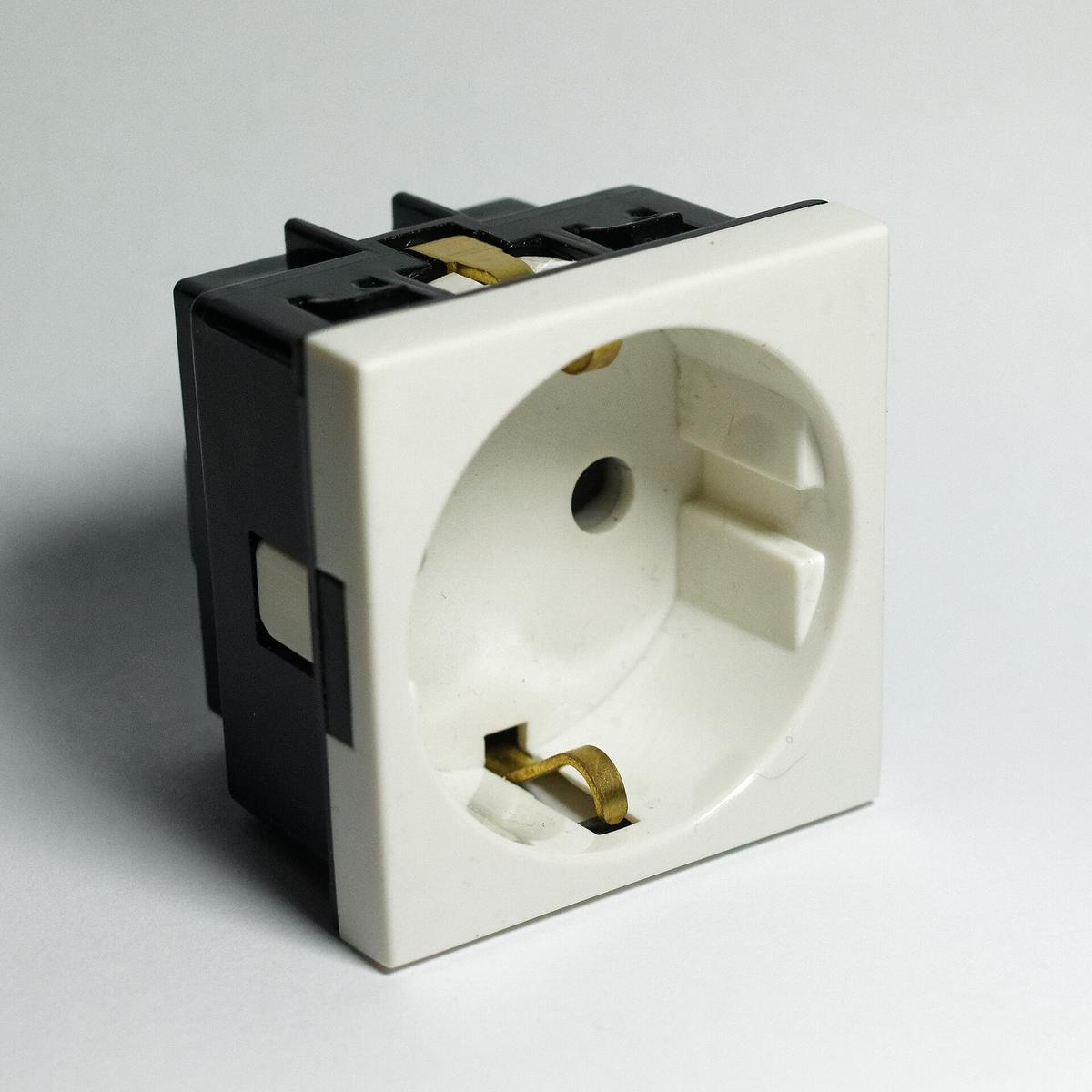
You pull into Frankfurt Hauptbahnhof on the S8 from the airport, phone at 12%, and reach for the outlet beside the seat. Your UK three pin plug does not fit. The round holes are deeper than you expect. The side clips need a Schuko plug. This is the moment the Germany power plug type stops being a trivia question and becomes your immediate problem. Germany uses Type F, also called Schuko, with two round pins 19 mm apart and spring loaded earth clips on each side. Type C Europlugs, the two pin rounded plug common on small chargers, also fit but with no earth connection. The voltage standard is 230 V at 50 Hz. You need both facts to pack correctly.
Germany Power Plug Type: Type F Schuko and What it Looks Like
Type F has two 4.8 mm round pins, 19 mm centre to centre, and a recessed outlet with two earth clips on the rim. Unlike Type E in France, the earth is a clip system, not a protruding pin. The outlet is recessed 15 mm deep, which means a Europlug (Type C) fits loosely but works for low power devices. You cannot plug Type F into a Type E outlet without an adapter, though combination Type E/F outlets exist in newer buildings.
Almost every German building built after 1950 uses Type F. Older guesthouses in the Harz Mountains or along the Baltic Coast may still have Type C outlets without earth, but those are rare. If your device needs an earth connection, you need a Type F plug.
What To Pack For Germany
If you travel from the UK, bring a Type G to Type F adapter. If you travel from the US, bring a Type A/B to Type F adapter. Universal adapters that cover multiple plug shapes are fine, but the cheaper single region adapters are smaller and less likely to fall out of the outlet. Do not bring a Type C only adapter from France or Belgium. It fits in Germany but lacks the earth clips, and some German outlets are too tight for the thinner Europlug pins.
.jpg)
Germany Voltage Standard: 230V, 50Hz, and What it Means for Your Electronics
The Germany voltage standard is 230 volts alternating current at 50 hertz. That is higher than the standard in the US, Canada, and Japan. Plugging a 110 V rated hair dryer or electric toothbrush into a 230 V outlet without a voltage converter will destroy the device, possibly with smoke and a blown fuse.
Most phone chargers, laptop power bricks, camera chargers, and USB adapters sold after 2010 are dual voltage. Check the label on the brick. It must say INPUT: 100 240 V. If it says 100 120 V only, leave it at home or buy a step down transformer. A step down transformer that handles 1000 watts or more weighs about a kilogram. For a one week trip, buy a local device in Germany instead.
For dual voltage devices, you still need the physical adapter. The adapter does not convert voltage. It only changes the shape of the pins. That is why the packaging on a travel adapter always says not for voltage conversion.
What Happens If You Ignore This
A US hair dryer rated 1875 watts at 120 V draws 15.6 amps. At 230 V, it would draw 8.1 amps for the same power, but the internal components are not rated for that voltage. The heating element may melt. The motor may burn out. The device may catch fire. The same applies to curling irons, electric shavers without dual voltage labels, and CPAP machines bought in North America. Always check the label before plugging in.
| Your Home Plug | Adapter Needed For Germany | Voltage Check Required |
|---|---|---|
| UK (Type G) | Type G to Type F | Check device label; most UK chargers are 100 240 V |
| US / Canada (Type A/B) | Type A/B to Type F | Check device label; US devices often 110 V only |
| Australia / NZ (Type I) | Type I to Type F | Check device label; Australia uses 230 V, adapter only |
| EU (Type C/E/F) | No adapter needed | Type F devices work directly; Type C fits but no earth |
| Japan (Type A/B) | Type A/B to Type F | Japan uses 100 V; voltage converter needed for 100 V only devices |
European Plug Adapter Germany: Where to Buy and Where Not to
The European plug adapter Germany you need is a Type F adapter. Buying one at the airport or Hauptbahnhof is risky. Shops at Frankfurt Airport and Berlin Hauptbahnhof charge two to three times the online price for a basic adapter. Worse, shops in German train stations close on Sundays. If you arrive on a Sunday afternoon in a smaller city, you may not find any electronics shop open until Monday morning. The same applies to public holidays, of which Germany has nine to thirteen depending on the Bundesland.
Buy your adapter before you leave home. Pack it in your carry on. If you forget or lose it, electronics retailers like MediaMarkt and Saturn carry adapters at reasonable prices. They are open Monday to Saturday, typically 10:00 to 20:00. Smaller shops in historic town centres may close at 18:00 and all day Wednesday in rural areas.
What About Buying In Tourist Shops
Souvenir shops near Cologne Cathedral or Neuschwanstein Castle sometimes sell travel adapters. They are often the cheapest universal type with loose pins that do not hold in German outlets. The outlet recess is 15 mm deep, and a flimsy universal plug may not make solid contact. The result is intermittent power that resets your phone every time the train hits a bump. Spend the extra few euros on a proper Schuko adapter from a real electronics retailer.


Germany Socket Type F: USB Ports in Hotels and Trains
The Germany socket type F is the only outlet you will find in hotels, train stations, and public buildings. USB integration is inconsistent. Hotels built or renovated since about 2018 often have USB A ports built into the bedside lamps or the outlet itself. Private holiday rentals and older guesthouses, especially in the Bavarian Alps or the Moselle Valley, typically do not. USB C is appearing in new build premium hotels but is not standard across all regions.
On Deutsche Bahn ICE trains, every seat has a Type F power outlet. USB ports are fitted on ICE 4 trains and some refurbished ICE 3 sets, but not on older ICE 1 or ICE 2 carriages. Regional trains are a gamble: newer rolling stock on routes like the Munich to Garmisch line may have USB, while older stock on branch lines in Saxony or the Harz often has no power at all. FlixBus and most long distance bus operators equip every seat with a USB port. The DB Navigator app will not tell you if your specific train has USB. Bring a power bank.
Travel Adapter for Germany: the One You Pack Versus the One You Wish You Had
The travel adapter for Germany you pack should be small, Type F specific, and have a label showing 16 amp rating. German outlets are rated for 16 amps, and a cheap adapter rated for 6 amps may overheat if you charge a laptop and a tablet simultaneously. A single Schuko adapter costs a few euros online. A universal adapter with replaceable heads costs more. The universal type is better for trips that continue beyond Germany into Austria, Switzerland, or Eastern Europe, all of which also use Type F.
Do not bring an adapter that combines Type C pins with a rounded body. The Europlug pins are 4.0 mm diameter, while Schuko pins are 4.8 mm. A Europlug in a Schuko outlet feels loose. It may fall out when the train lurches or when the cable pulls. A proper Schuko plug has a tighter fit and the earth clips hold it in place.
If You Pack Nothing Else
Pack one adapter per person plus a spare. You will need to charge a phone, a camera, a laptop, and possibly a power bank. Most German hotel rooms have two outlets, one near the desk and one near the bed. If you are in a twin room or sharing with a travel partner, you will fight over that one outlet. A power strip with a single Type F plug and multiple USB ports solves this. It must have a Schuko plug, not a Europlug, and be rated for 230 V.
Common Questions
Can I use a US plug in Germany without an adapter?
No. US Type A and B plugs have flat pins. German Type F outlets accept only round pins. You need a Type A/B to Type F adapter. If your device is 110 V only, you also need a voltage converter.
Is Type C (Europlug) safe for all devices in Germany?
Type C fits but does not connect to the earth clips. It is safe for low power double insulated devices like phone chargers. Do not use it for devices that need an earth connection, such as hair dryers, kettles, or power tools.
Do I need a voltage converter for a UK laptop in Germany?
Check the laptop power brick label. UK and Germany both use 230 V. If the label says INPUT 100 240 V, you only need a plug adapter. Most UK laptop chargers are dual voltage.
Can I buy a travel adapter at Frankfurt Airport?
Yes, but shops charge two to three times the online price. They are closed on Sundays. Buy online before your trip.
Do German hotels provide USB charging ports?
Hotels built or renovated since about 2018 often have USB A ports. Older guesthouses and holiday rentals typically do not. USB C is not standard. Bring your own adapter and a power bank.
Are there power outlets on German trains?
Every ICE and most IC train seats have Type F outlets. USB ports are on ICE 4 trains and some refurbished ICE 3 sets. Regional trains vary. FlixBus has USB at every seat.
What happens if I plug a 110 V device into a 230 V outlet by mistake?
The device will likely be destroyed immediately. The heating element or motor may melt. The device may catch fire. Always read the input voltage label before plugging in.
Read next
-

 Staying Connected in Germany With eSIM, Local SIM, or Roaming
Mobile data in Germany means navigating rural black spots, scarce free Wi-Fi, and mandatory passport registration for local SIM cards.
Staying Connected in Germany With eSIM, Local SIM, or Roaming
Mobile data in Germany means navigating rural black spots, scarce free Wi-Fi, and mandatory passport registration for local SIM cards.
-
 When to Visit Germany and What Each Season Actually Delivers
Germany's travel seasons are defined by school holidays, trade fairs, and Christmas markets. Here is when to go and when to avoid.
When to Visit Germany and What Each Season Actually Delivers
Germany's travel seasons are defined by school holidays, trade fairs, and Christmas markets. Here is when to go and when to avoid.
-
 Getting Around Germany Without Falling for the Flexpreis Trap
How to use Germany's train system, avoid a €60 fine for the wrong ticket, and understand the difference between flexible and advance fares.
Getting Around Germany Without Falling for the Flexpreis Trap
How to use Germany's train system, avoid a €60 fine for the wrong ticket, and understand the difference between flexible and advance fares.
-
 Who Needs a Visa for Germany and How the Application Actually Works
A clear breakdown of who needs a visa to enter Germany, who is exempt, and the step-by-step process for a Schengen visa application.
Who Needs a Visa for Germany and How the Application Actually Works
A clear breakdown of who needs a visa to enter Germany, who is exempt, and the step-by-step process for a Schengen visa application.
-
 Cash Is King in Germany and Your Card Will Often Be Useless
Germany remains a cash-first economy where many restaurants and shops refuse cards. Here is exactly where you need physical euros.
Cash Is King in Germany and Your Card Will Often Be Useless
Germany remains a cash-first economy where many restaurants and shops refuse cards. Here is exactly where you need physical euros.
-
 Is Germany Safe for Travelers and What Are the Actual Risks
Germany is a safe country, but petty theft at markets and fines on trains are real risks. Here is what to actually watch for.
Is Germany Safe for Travelers and What Are the Actual Risks
Germany is a safe country, but petty theft at markets and fines on trains are real risks. Here is what to actually watch for.
-
 A Ground-Level Logistics Guide to Independent Travel in China
First-time independent travel in China: what you need to know about visas, rail booking, eSIMs, mobile payments, and power adapters.
A Ground-Level Logistics Guide to Independent Travel in China
First-time independent travel in China: what you need to know about visas, rail booking, eSIMs, mobile payments, and power adapters.
-
 How Solo Travelers Stay Ahead of Flight Delays and Cancellations
How solo travelers can track inbound aircraft, claim rebooking rights, and adjust ground transport when flights go wrong — step by step.
How Solo Travelers Stay Ahead of Flight Delays and Cancellations
How solo travelers can track inbound aircraft, claim rebooking rights, and adjust ground transport when flights go wrong — step by step.
-
 Why Your eSIM Might Not Work Abroad and How to Check Before You Go
Buying an eSIM doesn't guarantee signal abroad. Learn why coverage fails by location and how to verify reach before you commit to a plan.
Why Your eSIM Might Not Work Abroad and How to Check Before You Go
Buying an eSIM doesn't guarantee signal abroad. Learn why coverage fails by location and how to verify reach before you commit to a plan.