Germany eSIM for Tourists, a Reliable Connection Without the Roaming Bill
Mobile data in Germany means navigating rural black spots, scarce free Wi-Fi, and mandatory passport registration for local SIM cards.
Mobile Data in Germany for Travellers Who Need a Reliable Connection
Germany is a federation of regions that feel like separate countries stitched together, and its geography is the first thing that breaks a traveller's data plan. The country is larger than most visitors expect. Free public WiFi is scarce. Mobile data black spots are common on intercity trains and in rural areas. For anyone searching for a germany esim for tourists, the real decision is not which product is cheapest. It is which option still works when an ICE train drops into a deep cutting in the Black Forest and the passenger next to you loses their signal entirely. The answer depends on which carrier your SIM rides on. That matters more in Germany than almost anywhere else in Western Europe.
Germany Local SIM Registration: What the Law Actually Requires
A local SIM in Germany requires passport registration by law. This is not a formality you can skip. Every prepaid SIM demands identity verification before activation. The process is the same whether you buy a card in a supermarket or a carrier shop. Registration methods are video identification online, PostIdent at a Deutsche Post branch, or an in-store identity check at the point of purchase. The data collected includes your full name, date of birth, nationality, and an address. For visitors, a hotel address is accepted.
Where to Buy and What to Bring
Buy a SIM at supermarkets such as Aldi, Lidl, Edeka, and Rewe, electronics retailers like MediaMarkt and Saturn, petrol stations, convenience stores, post offices, and carrier shops. You need your passport. Without it, you cannot activate the SIM at all. Registration is mandatory for all prepaid SIMs. No shop will sell you one without completing the check. If you arrive on a Sunday when most retail is closed, your only option for a physical SIM is a train station shop or a petrol station. Both require your passport and run the same registration process. The card refusal common in many restaurants and smaller shops is a different friction, but it points to the same German insistence on formality in everyday transactions.

Telekom, Vodafone, O2 Tourist SIM: the Network Choice That Defines Your Trip
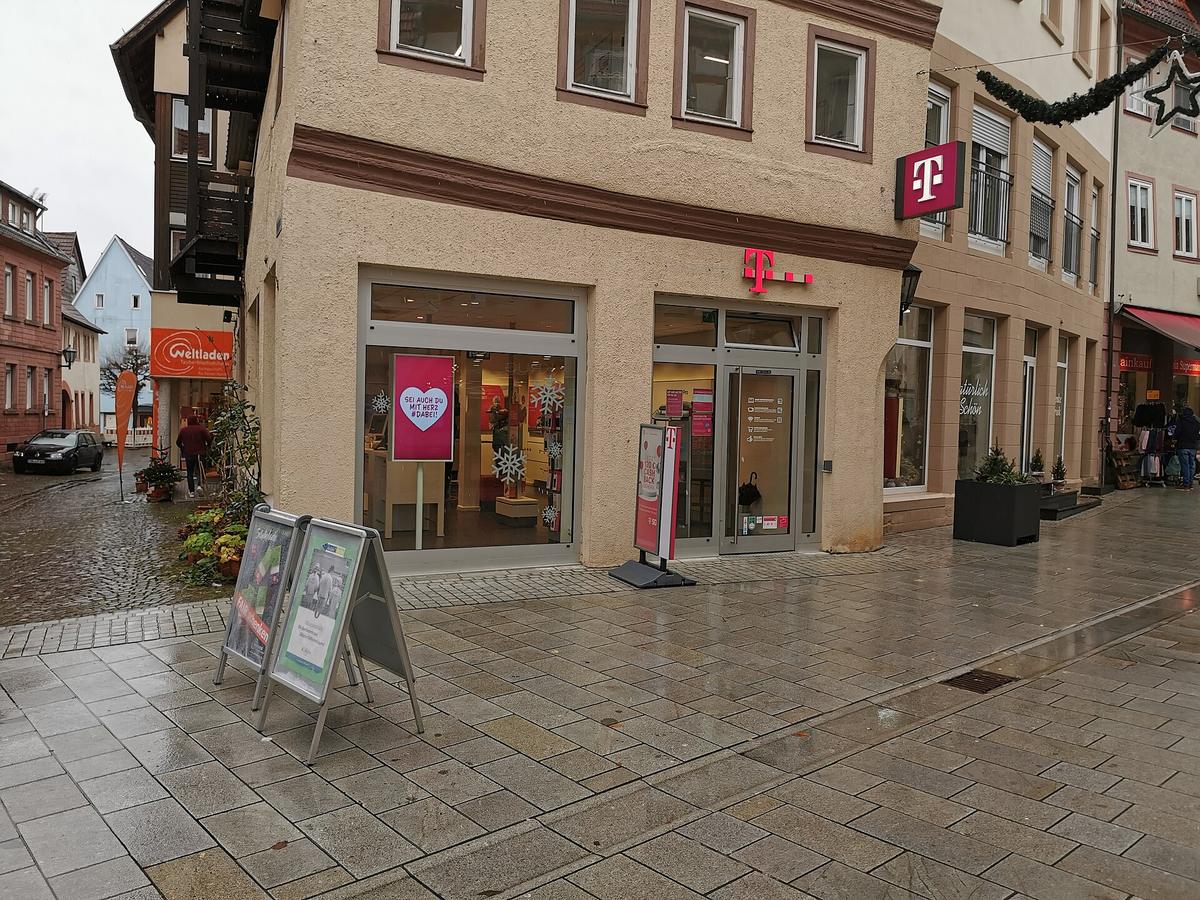
All three nationwide carriers in Germany support eSIM: Deutsche Telekom, Vodafone Germany, and Telefónica Germany, which operates as O2. They all offer prepaid eSIMs. Verify availability before you leave. Activation runs through the carrier's app or a QR code, with remote setup as standard. The carrier you pick is the most consequential decision you will make for your connectivity.
Deutsche Telekom
Deutsche Telekom has the best overall reach in Germany. Its 4G covers more than 98% of the population. If you are spending significant time on Deutsche Bahn ICE trains through rural high-speed sections, or in deep valleys in the low mountain ranges such as the Harz, Black Forest, or Bavarian Forest, Telekom is the carrier most likely to hold a signal. The downside is price. Telekom prepaid costs more than the equivalent from O2 or Vodafone, and the difference is not small. You pay for the coverage advantage. For a road tripper heading down the Moselle Valley or into Saxon Switzerland, that premium is justified.
Vodafone
Vodafone Germany sits in the middle. Its 4G also reaches more than 98% of the population. Vodafone performs almost as well as Telekom in most areas. In some city centres it can be faster. The gap appears in remote upland valleys: the Eifel, the Mecklenburg Lake District, and inside thick-walled historic buildings. If you are sticking to major cities and the main ICE corridors, Vodafone is a solid choice that costs less than Telekom. If you need a connection in the Harz Mountains or on a regional train through Brandenburg, you will feel the difference.
O2 (Telefónica Germany)
O2 uses the same population reach figures for 4G and 5G in its marketing. In practice, O2's infrastructure has more dead zones in rural areas and on trains than the other two. The tradeoff is price: O2 prepaid is the cheapest option. For a traveller who stays in Berlin, Munich, and Hamburg, and who uses WiFi in their hotel and in cafes, O2 is adequate. For anyone taking a regional train into the Bavarian Alps or cycling through the Moselle vineyards, O2 is the wrong choice. The savings are not worth losing data at the moment you need a map.
Roaming: The EU Card That Works When It Works
EU roaming regulation applies in Germany. Visitors with SIMs from other EU or EEA countries can use their domestic allowance without extra charges. That is the simplest option for EU residents. It requires no passport registration or local purchase. For non-EU visitors, roaming from a home carrier is the most expensive option per gigabyte, and it ties you to your home carrier's roaming partners, which may not be the strongest local choice. The upside is zero friction at arrival. The downside is cost and throttled speeds after a soft cap. If your roaming partner is O2 rather than Telekom, your train connectivity will suffer. Roaming trades price and performance for simplicity.
Germany Mobile Data Black Spots: Where Your Connection Drops and Why
Mobile data black spots in Germany are not travel-writer hyperbole. Coverage drops occur in genuine gaps, and the geography is predictable. On Deutsche Bahn ICE and IC long-distance trains, service is intermittent in tunnels and deep cuttings. Deutsche Bahn equips ICE trains with repeaters, but gaps persist on rural high-speed sections. On regional trains, the situation is worse. Rural branch lines in Brandenburg, Mecklenburg-Western Pomerania, and upland areas may have extended dead zones where no carrier has a signal at all.
Outside trains, the dead zones map to the country's geography. Deep rural valleys in the low mountain ranges, specifically the Harz, Eifel, Bavarian Forest, and Black Forest, are notorious for weak or absent signals. Remote Alpine areas in Bavaria lose signal predictably. Some sections of the Mecklenburg Lake District have no mobile data. Inside thick-walled historic buildings, including the half-timbered structures in Rothenburg ob der Tauber or the stone fortifications of the Porta Nigra in Trier, the signal falls apart regardless of carrier. No choice of provider can fix a building that acts as a Faraday cage. Download offline maps before you leave your accommodation. Carry relevant regional train timetable screenshots in your gallery.
Free WiFi Germany Scarcity: Why You Cannot Depend on Public Hotspots
A traveller arriving from much of Western Europe expects free public WiFi on every corner. The scarcity in Germany is a specific and persistent frustration. Public WiFi is common in hotels and hostels, and in some cafes, but less ubiquitous than in many other Western European countries. The legal framework changed in 2017 with an amendment to the Telemedia Act, which removed operator liability for user misconduct. That amendment made it easier for businesses to offer open WiFi, but uptake has been slow. Many smaller cafes and restaurants still do not offer it. Those that do often require a login via a splash page, and some demand a German mobile number for SMS verification, which is useless to a visitor without a local SIM.
The Train WiFi Reality
Free public WiFi is available on all ICE trains, but quality varies by route and train age. On a Frankfurt to Cologne ICE it works. On an ICE through the Saxon Switzerland region, it may stutter or drop entirely. Free public WiFi in regional trains is not standard. Some newer trains in certain states offer it, but you cannot rely on it for navigation. Your mobile data is your primary connection. Train WiFi is a backup at best.
Municipal and Airport WiFi
Free public WiFi is available at all major airports: Frankfurt, Munich, Berlin, Düsseldorf, Hamburg, Cologne Bonn, and Stuttgart. It is time-limited without payment. Some cities offer municipal free WiFi, such as Berlin's Free WiFi Berlin and Munich's M WLAN. Reach is patchy and often limited to specific squares or streets. You cannot build a trip around municipal WiFi. Treat public WiFi as a bonus, never as a plan.

Connecting Through the Black Spots: What to Do Next
Before you leave, decide where you are going and what you need connectivity for. Tracing the Saxon Switzerland sandstone spires at Bastei Bridge? Download offline maps before the S-Bahn leaves Dresden. A business traveller on the ICE corridor between Frankfurt and Cologne can get away with any carrier. A road tripper heading from the Baltic Coast to the Bavarian Alps should buy a Telekom prepaid eSIM before departure, activate it via QR code at the arrival airport, and accept paying more for the privilege of having a signal when the road bends into a deep valley. Check the Deutsche Bahn route map for the specific high-speed sections you will travel. Cross-reference those against the annual coverage reports published by each carrier. The answer is never a brand. The answer is a network.
Common Questions
Can I buy a local SIM at the airport when I land?
Yes, all major airports have carrier shops and electronics retailers that sell prepaid SIMs. Airport shops are open during flight hours, including Sundays. The same passport registration requirement applies at the airport; bring your passport.
Do I need to register my passport for an eSIM from a European provider?
Yes, if the eSIM is issued by a German carrier. The passport registration requirement applies to all prepaid SIMs, including eSIMs. Some eSIM providers based outside Germany may use different rules, but any eSIM that rides on a German network is subject to German law.
Is 5G available everywhere in Germany?
No. All three carriers report 5G reaching above 90% of the population in their most recent annual figures, but that leaves significant geographic area without 5G. In deep rural valleys, remote Alpine areas, and the Mecklenburg Lake District, you will fall back to 4G or lose signal entirely. The 3G network was decommissioned nationwide by the end of 2021, so your fallback is 4G or 2G.
Will my eSIM work on Deutsche Bahn trains?
It depends on which carrier your eSIM uses. On an ICE train through the Black Forest or Harz, a Telekom-based eSIM has the best chance of maintaining a connection. An O2-based eSIM will drop more frequently. Deutsche Bahn installs repeaters in ICE trains, but the gaps on rural high-speed sections persist regardless of the carrier.
Can I use my home carrier's roaming instead of buying a German SIM or eSIM?
Yes, but the cost is higher per gigabyte than a local prepaid, and your roaming partner in Germany determines your coverage. If your home carrier roams on O2, your connection in rural areas and on trains will be weaker than if it roams on Telekom. Check your carrier's roaming partner in Germany before you rely on it for navigation across the country.
Read next
-

 When to Visit Germany and What Each Season Actually Delivers
Germany's travel seasons are defined by school holidays, trade fairs, and Christmas markets. Here is when to go and when to avoid.
When to Visit Germany and What Each Season Actually Delivers
Germany's travel seasons are defined by school holidays, trade fairs, and Christmas markets. Here is when to go and when to avoid.
-
 Getting Around Germany Without Falling for the Flexpreis Trap
How to use Germany's train system, avoid a €60 fine for the wrong ticket, and understand the difference between flexible and advance fares.
Getting Around Germany Without Falling for the Flexpreis Trap
How to use Germany's train system, avoid a €60 fine for the wrong ticket, and understand the difference between flexible and advance fares.
-
 Who Needs a Visa for Germany and How the Application Actually Works
A clear breakdown of who needs a visa to enter Germany, who is exempt, and the step-by-step process for a Schengen visa application.
Who Needs a Visa for Germany and How the Application Actually Works
A clear breakdown of who needs a visa to enter Germany, who is exempt, and the step-by-step process for a Schengen visa application.
-
 Cash Is King in Germany and Your Card Will Often Be Useless
Germany remains a cash-first economy where many restaurants and shops refuse cards. Here is exactly where you need physical euros.
Cash Is King in Germany and Your Card Will Often Be Useless
Germany remains a cash-first economy where many restaurants and shops refuse cards. Here is exactly where you need physical euros.
-
 Is Germany Safe for Travelers and What Are the Actual Risks
Germany is a safe country, but petty theft at markets and fines on trains are real risks. Here is what to actually watch for.
Is Germany Safe for Travelers and What Are the Actual Risks
Germany is a safe country, but petty theft at markets and fines on trains are real risks. Here is what to actually watch for.
-
 How Much a Trip to Germany Actually Costs, Shaped by Region and Season
Germany trip costs split along regional lines, with Bavaria and trade-fair cities operating on a different budget logic than the Harz or Baltic Coast.
How Much a Trip to Germany Actually Costs, Shaped by Region and Season
Germany trip costs split along regional lines, with Bavaria and trade-fair cities operating on a different budget logic than the Harz or Baltic Coast.
-
 A Ground-Level Logistics Guide to Independent Travel in China
First-time independent travel in China: what you need to know about visas, rail booking, eSIMs, mobile payments, and power adapters.
A Ground-Level Logistics Guide to Independent Travel in China
First-time independent travel in China: what you need to know about visas, rail booking, eSIMs, mobile payments, and power adapters.
-
 How Solo Travelers Stay Ahead of Flight Delays and Cancellations
How solo travelers can track inbound aircraft, claim rebooking rights, and adjust ground transport when flights go wrong — step by step.
How Solo Travelers Stay Ahead of Flight Delays and Cancellations
How solo travelers can track inbound aircraft, claim rebooking rights, and adjust ground transport when flights go wrong — step by step.
-
 Why Your eSIM Might Not Work Abroad and How to Check Before You Go
Buying an eSIM doesn't guarantee signal abroad. Learn why coverage fails by location and how to verify reach before you commit to a plan.
Why Your eSIM Might Not Work Abroad and How to Check Before You Go
Buying an eSIM doesn't guarantee signal abroad. Learn why coverage fails by location and how to verify reach before you commit to a plan.