Understanding the Russia Power Plug Type and Your Travel Adapter
Russia uses 220V and European two-pin sockets. What plug type you need, what converter to pack, and what to leave at home.
Russian Sockets, 220 Volts, and the Plug You Actually Need
Thirty hours into the Moscow to Vladivostok journey, the man across the aisle in kupe plugs a kettle into a Schuko socket and offers you tea. This is when you need to know the Russia power plug type, not while unpacking in a Sheremetyevo hotel room at midnight. Russia runs 230 V at 50 Hz with two compatible socket standards: the European two-pin Type C (round pins, unearthed) and the Schuko Type F (round pins with spring-loaded side clips for the earth contact). Most sockets accept both. Your task is simpler than the visa paperwork: pack exactly one adapter.
Russia Voltage and Frequency: What Your Device Can Handle
Check the power supply label on every charger, laptop brick, and hair tool you plan to bring. If it lists a range covering 230 V and 50 Hz, you have dual voltage equipment. It needs a plug adapter and nothing else. Phone chargers, camera batteries, laptops, and electric toothbrushes fall into this category.
If your device is marked for 110 V only, it is single voltage and will be damaged or catch fire in a Russian socket. To use it, you need a step down transformer that converts 230 V to 110 V. A transformer rated for small electronics is packable. A hair dryer transformer weighs as much as a hardcover book. The practical fix is to buy a dual voltage travel hair dryer before you leave home. Searching Moscow electronics stores for a transformer is not how you want to spend your first day.
Frequency and Motor Driven Devices
The 50 Hz frequency matters for a clock radio, a turntable, or any appliance with a synchronous motor. A device designed for 60 Hz runs slower on 50 Hz without a frequency converter, and frequency converters are heavy, expensive, and almost never worth packing. Leave the motor driven gear at home. Charge everything via USB and you sidestep the entire problem.

Russia Travel Adapter Plug: Which One to Pack
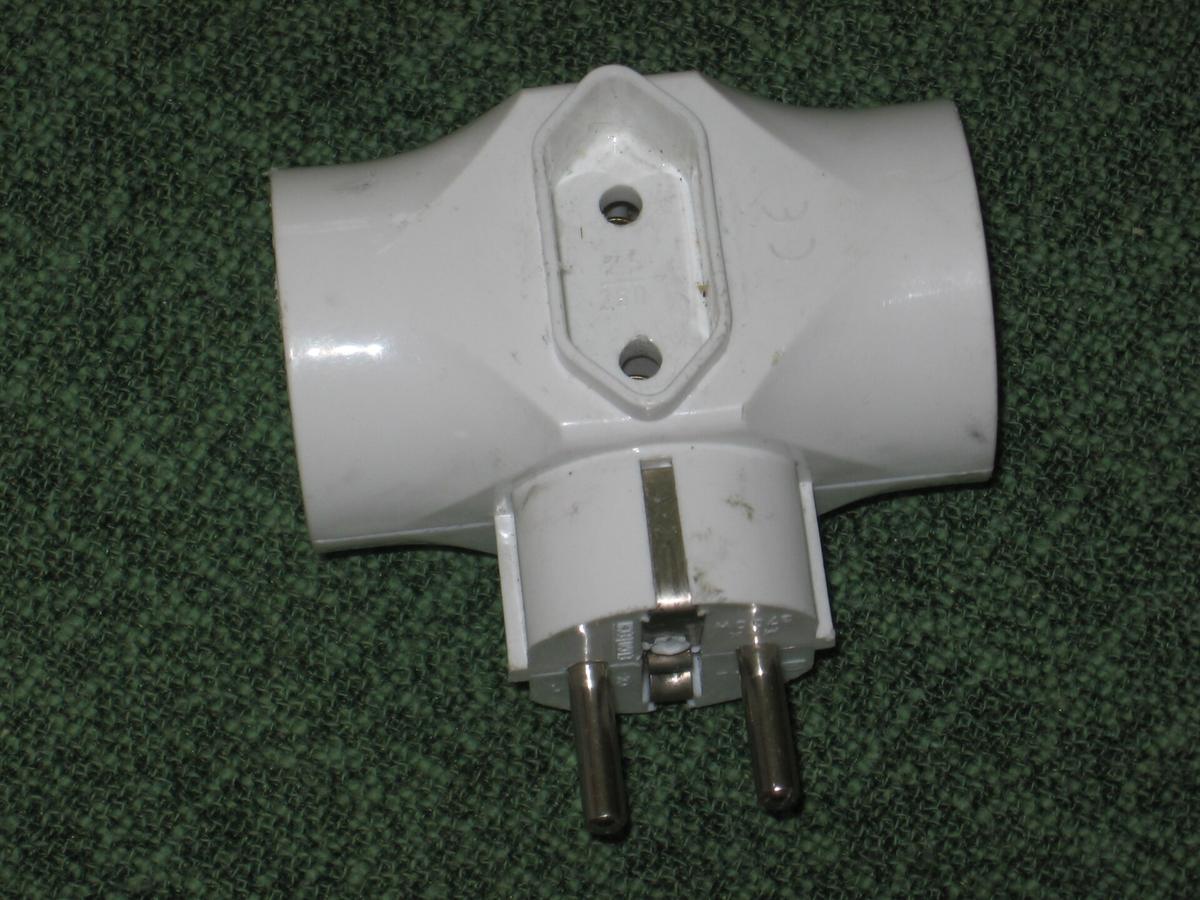
You need exactly one adapter: the Type C/F universal adapter. This small plastic block accepts both Type C and Type F plugs on the input side and delivers a two round pin output that fits Russian sockets. Buy it before you fly. Moscow airport electronics kiosks sell them at a steep markup and stock is unreliable after a delayed Aeroflot arrival.
Do not bring a Type C only adapter without the Schuko earth clips. Type C plugs fit Type F sockets, but Type F plugs do not fit Type C sockets. Russian hotels built or renovated after 2015, plus all Sapsan and Lastochka first class compartments, use Type F sockets almost exclusively. A Type C only adapter leaves you unable to plug in anything with a side clip earth, which includes many European laptop power bricks.
What Moscow Hotel Socket Type Looks Like
A Moscow hotel socket is a recessed round hole, roughly 2 cm deep, with two 4.8 mm holes spaced 19 mm apart. Older Soviet era buildings may show a shallower socket that accepts Type C plugs only. Mid range and business hotels built after 2015 install Schuko Type F sockets recessed into the wall or floor. The universal adapter covers both. Budget hostels and private apartments rented through booking platforms may have a mix. If you arrive to find a Soviet era socket that seems loose, plug your adapter in gently and do not wiggle it. A loose connection in a 230 V circuit creates heat.
| Device | Typical Label | Adapter Needed | Converter Needed |
|---|---|---|---|
| Phone / tablet charger | Dual voltage | Type C/F | No |
| Laptop power brick | Dual voltage | Type C/F | No |
| Camera battery charger | Dual voltage | Type C/F | No |
| Travel hair dryer | Dual voltage | Type C/F | No |
| US hair dryer (110 V only) | 110 V only | Type C/F | Step down transformer required |
| Electric razor (rechargeable) | Dual voltage | Type C/F | No |
| Motor driven clock / turntable | 110 V, 60 Hz | Type C/F | Frequency converter required |

Russia Power Strip Packing: Why You Need One on the Train
A compact two or three outlet power strip with a Type F plug on the input side is the single most useful thing you can pack for a Russian railway journey. In a kupe compartment (four berth, second class), there is one socket in the corridor and sometimes a second socket hidden behind a panel near the folding table. Three adults charging phones, a camera, and a tablet will not fit into one socket. A power strip gives you three outlets from one socket and turns a tense negotiation into a non event.
On platzkart (third class, open dormitory) compartments, sockets are scarce. You may find one at the end of the carriage near the provodnik cabin or one every four compartments in newer rolling stock. Bring a power strip so you can share the single available socket with your bunk mates. Do not expect USB provision on long distance trains: USB A sockets are available at 230 V shaver style sockets in first class compartments on branded trains such as Sapsan, Lastochka, and Strizh, but they are not guaranteed in kupe or platzkart. RZD does not publish a consistent specification for USB ports across its fleet. Bring your own strip, a Type F plug, and a car length of patience.
USB Provision In Hotels And Other Accommodation
USB A sockets are common in hotels built or renovated after 2015, but less frequent in homestays, guesthouses, and Soviet era hotels. USB C is rare except in international chain hotels opened after 2020. Budget accommodation will give you a wall socket and nothing else. A multi port USB charger plugged into your Type C/F adapter covers this gap reliably. Pack a 2A or 3A per port charger, not the tiny cube that came with your phone, because you will be charging a phone, a battery pack, and a Kindle simultaneously every night.
Frequently Asked Questions About Russian Power Sockets
Do I need a voltage converter for Russia?
Only if your device is marked for 110 V and does not list a range covering 230 V on its label. Dual voltage devices need only a plug adapter.
Can I use a US plug in Russia with just a prong adapter?
No. A US two prong plug has flat pins. Russian sockets accept only round pins of 4.0 to 4.8 mm diameter. You need a Type C/F adapter that converts flat pins to round pins.
What happens if I plug a 110 V device into a Russian socket without a transformer?
The device will receive 230 V. The internal power supply will overload, overheat, and likely fail within seconds. In some cases it can smoke or catch fire. Check the label before plugging anything in.
Are USB sockets common in Russian hotels?
USB A sockets are common in hotels built or renovated after 2015. They are less frequent in homestays, guesthouses, and Soviet era hotels. USB C is rare except in international chain hotels opened after 2020.
Is there USB charging on the Trans Siberian Railway?
USB A sockets are available in first class compartments on branded trains Sapsan, Lastochka, and Strizh. They are not guaranteed in kupe (second class) or platzkart (third class) compartments. Bring a power strip and a multi port USB charger.
What socket type do Moscow and St Petersburg hotels use?
Most hotels use Schuko Type F sockets, which are round and recessed with two 4.8 mm holes. Older hotels may have Type C shallow sockets. A Type C/F universal adapter works in both.
Can I buy a plug adapter at Moscow Sheremetyevo Airport?
Yes, but expect a steep markup for a basic Type C/F adapter compared to buying one before departure. Stock at airport kiosks is unreliable after delayed arrivals. Buy before you fly.
Read next
-
 Staying Connected in Russia With eSIM Local SIM or Roaming
How to get a working mobile connection in Russia, why a passport is required, and where the signal disappears on long train routes.
Staying Connected in Russia With eSIM Local SIM or Roaming
How to get a working mobile connection in Russia, why a passport is required, and where the signal disappears on long train routes.
-
 Best Time to Visit Russia by Season and Region
When to go to Russia and what each season actually does to transport, prices, and what you can see. Seasonal trade-offs, not a single month.
Best Time to Visit Russia by Season and Region
When to go to Russia and what each season actually does to transport, prices, and what you can see. Seasonal trade-offs, not a single month.
-
 Getting Around Russia by Train Bus and Ride Hailing
Russian Railways, marshrutka, elektrichka, and Yandex Go. How Russia actually connects and what the map oversells for travellers.
Getting Around Russia by Train Bus and Ride Hailing
Russian Railways, marshrutka, elektrichka, and Yandex Go. How Russia actually connects and what the map oversells for travellers.
-
 Russia Visa Requirements and the Invitation Letter Process
Russia visa requirements, the invitation letter, and the registration rule that catches independent travellers out. What to do before and after arrival.
Russia Visa Requirements and the Invitation Letter Process
Russia visa requirements, the invitation letter, and the registration rule that catches independent travellers out. What to do before and after arrival.
-
 Paying for Things in Russia With Rubles and Cards
Russian rubles, Mir cards, and where cash still wins. What foreign visitors can and cannot pay with across Russia today.
Paying for Things in Russia With Rubles and Cards
Russian rubles, Mir cards, and where cash still wins. What foreign visitors can and cannot pay with across Russia today.
-
 Reading Russia Safety Advice Without Being Misled
Reading safety advice about Russia without being misled by it. Real risks, overstated fears, and what independent travellers should watch.
Reading Russia Safety Advice Without Being Misled
Reading safety advice about Russia without being misled by it. Real risks, overstated fears, and what independent travellers should watch.
-
 A Ground-Level Logistics Guide to Independent Travel in China
First-time independent travel in China: what you need to know about visas, rail booking, eSIMs, mobile payments, and power adapters.
A Ground-Level Logistics Guide to Independent Travel in China
First-time independent travel in China: what you need to know about visas, rail booking, eSIMs, mobile payments, and power adapters.
-
 How Solo Travelers Stay Ahead of Flight Delays and Cancellations
How solo travelers can track inbound aircraft, claim rebooking rights, and adjust ground transport when flights go wrong — step by step.
How Solo Travelers Stay Ahead of Flight Delays and Cancellations
How solo travelers can track inbound aircraft, claim rebooking rights, and adjust ground transport when flights go wrong — step by step.
-
 Why Your eSIM Might Not Work Abroad and How to Check Before You Go
Buying an eSIM doesn't guarantee signal abroad. Learn why coverage fails by location and how to verify reach before you commit to a plan.
Why Your eSIM Might Not Work Abroad and How to Check Before You Go
Buying an eSIM doesn't guarantee signal abroad. Learn why coverage fails by location and how to verify reach before you commit to a plan.