Finding the Right Netherlands Power Plug Type Before You Pack
The Netherlands uses Type C and Type F sockets at 230V. Recessed Dutch sockets can defeat bulky universal adapters. Pack the right plug.
You Are Standing in the Wrong Shop at Schiphol
You have landed at Amsterdam Schiphol. You walk past the gates, past the Albert Heyn, and into the electronics shop near the main hall because you need a travel adapter for the Netherlands. The universal adapters on the shelf look right. They are not.
The Netherlands power plug type is Type C, the ungrounded Europlug with two round pins, and Type F, the earthed Schuko plug with side spring clips. The voltage is 230 V at 50 Hz. Those bulky all-in-one adapters with multiple sliders and a USB hub do not stay in the recessed round sockets found here. You buy the wrong one. You spend the rest of the trip charging your phone on a laptop. Do not buy that adapter. Buy the compact one.
.jpg)
Dutch Voltage and Frequency: 230 V at 50 Hz
The Dutch voltage and frequency standard is 230 volts at 50 hertz. Every wall socket in the Netherlands delivers this. If your device has a power brick or a label that reads INPUT: 100-240 V, 50/60 Hz, the phrase "dual voltage", you only need a physical plug adapter. No voltage converter. Check the label before you pack. Most phone chargers, laptop bricks, camera battery chargers and electric toothbrush bases carry this rating.
Single-Voltage Devices: Leave Them or Buy a Transformer
Hairdryers, straighteners and electric shavers from the United States or Canada do not. A single-voltage hairdryer plugged into a 230 V socket will burn out in under a second. If your device is single-voltage only, leave it at home or buy a step-down transformer. Transformers are heavy, hot and rarely worth the suitcase space. The failure case is a melted appliance in an Amsterdam hotel bathroom at 11 pm. There is no late-night electronics shop. Pack a dual-voltage travel hairdryer from home and skip the transformer entirely.
Type C and Type F Socket Netherlands: What Fits and What Does Not
The Recessed Socket Problem
The Type C and Type F socket the Netherlands uses is physically different from what many travellers expect. The socket is recessed. The hole your plug pins go into sits at the bottom of a rounded plastic crater, about 1.5 cm deep, surrounded by a raised rim. A standard Europlug, the small two-pin plug with no earth sold with most phone chargers in Europe, fits flush. A Type F Schuko plug, with its two 4.8 mm pins and side spring clips, also fits.
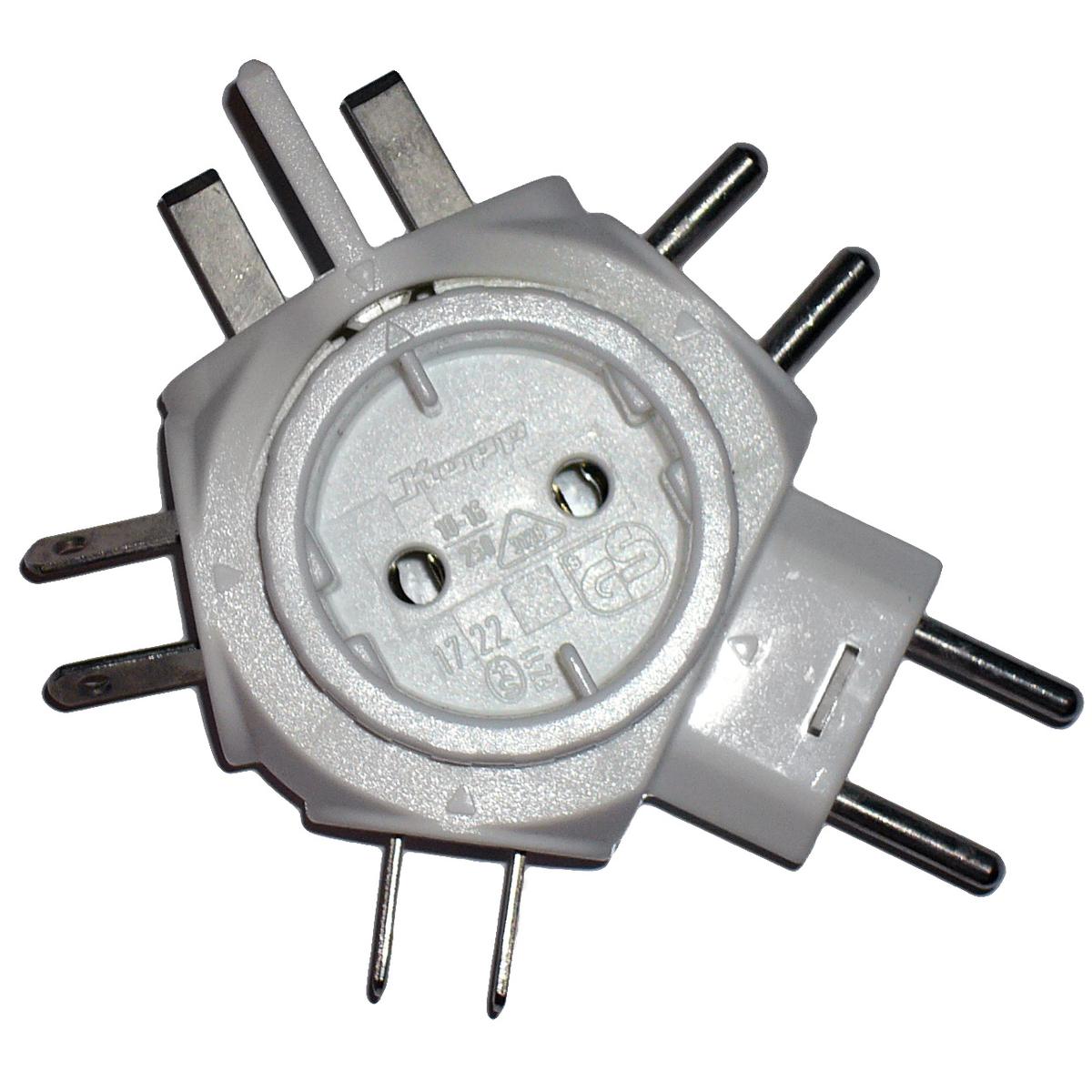
A large universal adapter does not. The kind with three or four sliders and a fat rectangular body is too wide to sit inside the recess. The adapter hangs out, tilts, or falls out of the socket under the weight of its own cable.
What to Buy Instead
The solution is an adapter that ends in a slim Type C body. The smallest and most reliable option is a simple Type C plug attached to a single USB-A or USB-C port. These are sold at any electronics shop near the Netherlands. If you are arriving from the United Kingdom, the United States, Canada or Australia, buy one before you arrive or pick one up at the Schiphol kiosk after baggage claim. The kiosk knows which ones work.
| Your Home Plug Type | Used In | Adapter You Need |
|---|---|---|
| Type G (three rectangular prongs) | United Kingdom, Ireland, Singapore | Type G to Type C/F adapter |
| Type A/B (two flat pins, with or without a third round pin) | United States, Canada, Japan, Mexico | Type A/B to Type C/F adapter |
| Type I (two flat pins at a V-angle, with a vertical earth pin) | Australia, New Zealand, Argentina | Type I to Type C/F adapter |

Travel Adapter for Netherlands: the Compact Europlug Wins
A travel adapter for the Netherlands needs to do one thing: connect your plug to a recessed Type C or Type F socket. The most reliable version is a small adapter that plugs directly into the wall and accepts your home plug on its other side. Brands such as Skross, Vinnic and the official Schiphol travel shop stock these.
Avoid the folding multi-country adapters with a dozen sliding prongs. They are heavy. They break after ten uses. Their bulk pushes them out of the recessed socket. A two-in-one is fine: you need Type C for most sockets and Type F for older earthed installations. Type C fits both. If you buy a Type C adapter with a single USB-A port built in, you can charge your phone directly without carrying the charger brick.
USB in Dutch Hotels and Rentals
Many newer hotels and holiday rentals in the Netherlands now include USB-A ports in the wall or bedside lamp. USB-C ports appear in new builds and renovated hotels, though they are less common in pre-2015 budget hotels and private rentals. For those, bring your own charger and the compact adapter. Carry one adapter per person. Do not carry a power strip unless you have three devices charging simultaneously at every stop. The extra weight is wasted.
Who Should Plan Ahead and Who Should Skip This Worry
Power sockets, voltage and the adapter you actually need matter for any traveller crossing into the Netherlands from a country that does not use Type C or Type F plugs. That is most travellers: the United Kingdom, the United States, Canada, Australia, New Zealand, Japan and much of Asia.
The few who can skip this entirely are travellers arriving from continental Europe. Germany, France, Italy, Spain, Belgium, Switzerland and Austria all use Type C and Type F plugs already. If your home country uses Type G (UK), Type A or B (North America) or Type I (Australia, New Zealand), the one thing that most often goes wrong is buying a bulky universal adapter that cannot stay in a recessed socket, then spending the first evening of a seven-day, two-city trip in Amsterdam or Rotterdam looking for an open electronics shop at 7 pm when every supermarket and store is closed. Do not be that traveller. Buy the compact adapter before you leave.
Frequently Asked Questions About Netherlands Power Plugs
Do I need a voltage converter for the Netherlands?
Only if your device is single voltage. Most phone and laptop chargers are dual voltage (100-240 V) and need only a plug adapter. Check the label on the power brick before you pack.
Will my US plug work in a Dutch socket with just a prong adapter?
A US Type A or Type B plug will not physically enter a Dutch socket. You need a Type A/B to Type C/F adapter. A prong converter that only bends the flat pins will not create the correct spacing or shape for the round holes.
Can I charge my phone on the train in the Netherlands?
Yes on NS Intercity Direct and most refurbished Intercity trains. USB ports are not guaranteed on older Sprinter and regional train stock. FlixBus services operating domestic routes also have USB charging.
Are there USB ports at Schiphol Airport?
Yes. Charging points are available in lounges, at gates and in seating areas throughout the terminal. Regional airports such as Eindhoven, Rotterdam The Hague and Groningen have limited availability.
What is the difference between Type C and Type F sockets?
Type C is ungrounded, with two round pins only. Type F is earthed, with two round pins plus side spring clips. A Type C plug fits both. A Type F plug fits only Type F sockets. Most Dutch sockets are Type F, especially in buildings built or renovated after 1990.
Will a universal travel adapter from Amazon work?
It may, but check the width of the adapter body. If the plastic casing is thicker than about 2 cm, it will not sit inside a recessed Dutch socket. The adapter will fall out under its own weight. Buy a slim Type C specific adapter instead.
Can I use my Australian appliance with just an adapter?
If the appliance is dual voltage, yes. Australian sockets (Type I) deliver 230 V at 50 Hz, the same as the Netherlands. A physical plug adapter from Type I to Type C/F is all you need. If the appliance is single voltage and rated for Australia's 230 V, it will also work, same voltage, same frequency.
Read next
-
 Staying Connected in The Netherlands With eSIM, Local SIM or Roaming
Compare eSIM, local SIM, and roaming options for The Netherlands, where 5G coverage is near-universal but NS train Wi-Fi has limits.
Staying Connected in The Netherlands With eSIM, Local SIM or Roaming
Compare eSIM, local SIM, and roaming options for The Netherlands, where 5G coverage is near-universal but NS train Wi-Fi has limits.
-
 When to Visit the Netherlands and What Each Season Actually Does to Your Trip
April brings tulips and King's Day crowds. July and August are warmest but rainy. Winter closes many small-town attractions. Choose your season by the trade-offs.
When to Visit the Netherlands and What Each Season Actually Does to Your Trip
April brings tulips and King's Day crowds. July and August are warmest but rainy. Winter closes many small-town attractions. Choose your season by the trade-offs.
-
 Moving Around the Netherlands by Train, Bike, and the Gaps the Map Oversells
Dutch trains are excellent, but checking in on the wrong card reader when changing operators can get you fined. Here is how the system works.
Moving Around the Netherlands by Train, Bike, and the Gaps the Map Oversells
Dutch trains are excellent, but checking in on the wrong card reader when changing operators can get you fined. Here is how the system works.
-
 Who Needs a Visa for the Netherlands and How the Application Actually Works
Whether you need a visa for the Netherlands depends on your passport. Here is the Schengen application process, required documents, and realistic timelines.
Who Needs a Visa for the Netherlands and How the Application Actually Works
Whether you need a visa for the Netherlands depends on your passport. Here is the Schengen application process, required documents, and realistic timelines.
-
 Paying for Things in the Netherlands Without Your Card Getting Declined
Many Dutch shops refuse Visa and Mastercard. Here is why, where cards work, where cash still matters, and how OVpay changes transport payments.
Paying for Things in the Netherlands Without Your Card Getting Declined
Many Dutch shops refuse Visa and Mastercard. Here is why, where cards work, where cash still matters, and how OVpay changes transport payments.
-
 Reading Safety Advice About the Netherlands Without Being Misled by It
The Netherlands is safe by every statistic, but bicycle-path collisions and pickpocketing on Amsterdam trams are the real visitor risks to understand.
Reading Safety Advice About the Netherlands Without Being Misled by It
The Netherlands is safe by every statistic, but bicycle-path collisions and pickpocketing on Amsterdam trams are the real visitor risks to understand.
-
 A Ground-Level Logistics Guide to Independent Travel in China
First-time independent travel in China: what you need to know about visas, rail booking, eSIMs, mobile payments, and power adapters.
A Ground-Level Logistics Guide to Independent Travel in China
First-time independent travel in China: what you need to know about visas, rail booking, eSIMs, mobile payments, and power adapters.
-
 How Solo Travelers Stay Ahead of Flight Delays and Cancellations
How solo travelers can track inbound aircraft, claim rebooking rights, and adjust ground transport when flights go wrong — step by step.
How Solo Travelers Stay Ahead of Flight Delays and Cancellations
How solo travelers can track inbound aircraft, claim rebooking rights, and adjust ground transport when flights go wrong — step by step.
-
 Why Your eSIM Might Not Work Abroad and How to Check Before You Go
Buying an eSIM doesn't guarantee signal abroad. Learn why coverage fails by location and how to verify reach before you commit to a plan.
Why Your eSIM Might Not Work Abroad and How to Check Before You Go
Buying an eSIM doesn't guarantee signal abroad. Learn why coverage fails by location and how to verify reach before you commit to a plan.