Choosing a Netherlands eSIM for Travel That Keeps You Connected
Compare eSIM, local SIM, and roaming options for The Netherlands, where 5G coverage is near-universal but NS train Wi-Fi has limits.
Mobile Data and Connectivity in the Netherlands for Travellers
The single most useful fact about staying connected in the Netherlands is this: you will have a signal almost everywhere, including the heathland of the Veluwe interior and the Frisian lake district. The Netherlands has near universal 5G coverage, so the question is not whether your phone will work but how you want to pay for that access, and whether you need a Dutch phone number to make it all function. For most travellers, a netherlands esim for travel is the simplest option because it activates before you land at Schiphol and saves you the hunt for a physical shop. But that answer shifts if you plan to book restaurants by phone, log into Dutch banking apps, or rely on public Wi Fi as a backup. The decision tree is straightforward once you map your own itinerary against the country's specific quirks.
Best ESIM Netherlands: Why it Suits Most Trips
An eSIM from a provider like uPhone connects you to networks that include KPN, Vodafone, and Odido (formerly T Mobile). The advantage is speed. You buy and install the eSIM before your flight, and the moment you switch off airplane mode at Schiphol, data starts flowing. No queue at a service desk. No fumbling with a SIM ejector tool in a luggage queue.
The downsides are two. First, an eSIM gives you data but rarely a Dutch phone number, which can trip you up if a restaurant reservation system requires a local contact number or if a Dutch service sends a two factor authentication SMS to a number it does not recognise. Second, data only eSIMs from some providers route your traffic through a foreign IP, meaning some Dutch websites and apps may not perform as well as they would on a domestic connection. For data heavy activities, which is what most travellers need for maps, messaging, and the 9292 app, the eSIM works flawlessly.
_02.jpg)
Dutch SIM Card for Tourists: When You Need a Local Number
Why You Need a +31 Number
Buying a physical Dutch SIM card at Schiphol or from a supermarket or electronics retailer gives you something an eSIM cannot: a genuine +31 number. You need one if you plan to call ahead for dinner reservations at restaurants that still operate by phone, or if you rely on two factor authentication SMS codes that a foreign number may not receive.
Where to Buy and What to Bring
The registration process is straightforward. EU and EEA citizens show a passport or national ID. Non EU travellers show a passport. Proof of address is not required for prepaid SIMs. Buy SIMs from Lebara, Lyca Mobile, or Simyo at an Albert Heijn supermarket, a Primera convenience store, or a MediaMarkt electronics shop. The drawback is that you have to find one of those shops open, which is harder on Sundays when most supermarkets and many high street stores outside city centres are closed. If your flight lands on a Sunday afternoon, an eSIM is the safer fallback.
Netherlands Mobile Data Coverage: Where it Drops
You can count on strong 4G LTE coverage nationwide and 5G in major cities like Amsterdam, Rotterdam, Utrecht, and The Hague, with suburban expansion ongoing. The weak spots are known. Ferry crossings to the Wadden Sea islands lose signal in the middle of the crossing. Some remote dunes on Vlieland or Terschelling can be patchy. The interior of the Veluwe national park, away from the main roads and the Kröller Müller Museum, has pockets where the forest canopy and low population density thin the signal. Parts of Zeeland near the sea dykes, especially around the Delta Works storm surge barriers, can be spotty. Flevoland, the polder province, has stretches of very low population density where coverage is acceptable but not fast. In practice, these gaps are short lived. You are rarely more than fifteen minutes from a village or main road where the signal returns. The real connectivity friction in the Netherlands is not coverage. It is the cost and the registration steps.
uPhone Netherlands Review: Data Only, No Number
uPhone is the most commonly used eSIM provider for the Netherlands. It works on all three major networks, KPN, Vodafone, and Odido, and installation takes under two minutes. The data packages are priced by volume and validity period, not by speed, so you get the same 4G and 5G speeds regardless of which package you buy.
The trade off is that uPhone does not provide a Dutch phone number. That matters more in the Netherlands than in some other European countries because Dutch restaurant booking systems and ticket delivery default to SMS confirmation. Book a timed slot at the Anne Frank House or the Van Gogh Museum through the official website, and you use email. Try to book a table at a small Rotterdam bistro by phone, and a foreign number may not ring through correctly. uPhone is the best choice for a traveller who will do all booking online, use WhatsApp for calls, and never need to dial a Dutch landline. For anyone else, the slight extra effort of picking up a local SIM at Schiphol or a supermarket may be worth it.
Free WiFi Netherlands Trains: the NS Reality
How the NS WiFi Works
The free WiFi on NS trains works but has limits you should plan around. Connect by registering once with an email address on the NS portal. It takes about thirty seconds. After that, the connection re establishes automatically on future journeys. The bandwidth is sufficient for messaging, loading a route on 9292, and checking museum opening hours. It is not enough for a video call or a stable VPN connection. The signal drops in tunnels and under bridges, and it becomes unreliable on intercity routes that pass through the Flevoland polder where coverage is thinner.
A Better Backup Plan
Do not rely on NS train WiFi for a work call or for anything that requires consistent uptime. The better habit is to download the 9292 app while you still have a strong signal and cache the day's routes before you board. The 9292 app is the non negotiable transport planner for the Netherlands. It integrates NS trains, regional operators like Arriva and Keolis, trams, buses, and metro across every city. It needs live data in the field to show real time departures and disruptions. WiFi alone cannot provide that with full reliability.
Roaming: the EU Data Zone Trap
If your home mobile plan includes EU roaming, the Netherlands is covered at no extra cost. That is the simplest option of all. No eSIM to install. No SIM card to insert. No registration to complete.
The trap is that "unlimited" roaming from many non EU providers throttles speed after a data cap, often 5 to 12 GB per month. If you use your phone for navigation, streaming music while cycling, and uploading photos, you burn through that limit before day five. Check your provider's fair use policy before you leave. The second trap is that some carriers from outside Europe do not include the Netherlands in their free roaming zones and charge per megabyte at rates that rival a hotel mini bar. If your plan covers the Netherlands, roaming is the best option because it preserves your home number for two factor authentication and gives you a local IP for Dutch websites. If your plan does not cover the Netherlands, an eSIM is cheaper than a single day of pay per use roaming.

Public WiFi Pitfalls: Payment and Registration
Public WiFi is common in hotels, cafes, libraries, and NS train stations. City centres do not have a single municipal free WiFi network, so you hop between individual networks. Many open networks require you to log in with an email address or an SMS code. Without a local number, the SMS based login will fail.
Hotels in the Canal Belt and Rotterdam Centrum almost always offer free WiFi, but the speed varies with occupancy. A property full of guests streaming video will slow to a crawl by 21:00. Plan for public WiFi as a supplement, not a primary connection. The risk of relying on it is that you lose connectivity just when you need to pull up a boarding pass, check a train platform, or find the nearest public toilet, which costs cash or contactless payment at train stations and museums.
What You Actually Need Data for in the Netherlands
Navigation and Transit
Your phone in the Netherlands will do four essential things, and each one places a different demand on your connection. First, the 9292 app for public transport planning. This is the single most important app on your phone. It covers every operator in the country, including NS, Arriva, Blauwnet, Connexxion, Keolis, and Qbuzz, and it shows real time departures, platform changes, and disruptions. Second, museum ticket portals. Buy timed entry for the Rijksmuseum, Van Gogh Museum, and Anne Frank House weeks in advance, but access the tickets on your phone at the entrance.
Payments and Cycling
Third, contactless payment for transit. Check in and out of trains using your phone's digital wallet or a physical card, which requires the phone to have battery and connectivity. Fourth, navigation for cycling. The nationwide numbered node cycle network, the Fietsknooppunten system, works best when you can look up the next node number on your screen. None of these require high bandwidth. They require consistent, always on data. That is why a one time setup like an eSIM or roaming beats the hassle of hunting for open WiFi networks.
The Verdict: Which Option for Which Traveller
The decision breaks down into three profiles. If you are a slow traveller cycling between small historic towns like Leiden, Gouda, and the villages of the Veluwe, get an eSIM for immediate connectivity. You will not be near a telecom shop when your data runs out. If you are a family visiting the interactive museums of Amsterdam, the Efteling theme park, and the Keukenhof tulip gardens, buy a local Dutch SIM at Schiphol on arrival so you have a local number for restaurant reservations and activity confirmations. If you are on a structured itinerary of seven days or more, with hotel WiFi every night and advance bookings for everything, roaming on your existing plan will probably cover you. The one constant: do not rely on NS train WiFi or open cafe networks as your primary connection. The day you miss a train because 9292 failed to load is the day an eSIM would have paid for itself.
Common Questions
Can I use an eSIM from Airalo if I only have one phone without dual SIM capability?
Yes. You install the eSIM as your primary data line and keep your physical SIM active for calls and SMS. On an iPhone, set the eSIM as the data line and the physical SIM as the voice line. On Android, the setting is called "primary data SIM". Your home number continues to ring, and your data runs on the Dutch network. This works as long as your phone is eSIM compatible and carrier unlocked.
Do I need to register a local SIM with a passport if I am from outside the EU?
Yes. Non EU and EEA citizens must show a passport to purchase a prepaid SIM in the Netherlands. The retailer scans or copies the passport at the point of sale. Proof of residence is not required. EU and EEA citizens can register with a national ID card or passport.
Will my contactless bank card work on NS trains and trams?
Yes. Debit and credit cards with Maestro, V Pay, Mastercard, or Visa work for direct check in and check out on NS trains, trams, buses, and metro. The contactless rollout was completed in 2023. One common mistake is failing to check in on a separate card reader when transferring between train operators, for example from NS to Arriva, which can result in a fine or incorrect charge.
Is public WiFi in the Netherlands safe for banking and online purchases?
Public WiFi in hotels, cafes, and stations is unencrypted. Avoid logging into banking apps or making purchases on open networks unless you are using a VPN. If you need to manage money or buy tickets on the move, use your mobile data connection instead. The data from an eSIM or local SIM is encrypted through the mobile network.
What is the 9292 app and do I need it?
The 9292 app is the integrated public transport planner for the Netherlands. It covers all train, tram, bus, metro, and ferry operators in one interface, showing real time departures, platform numbers, and disruptions. It requires live data to function fully. Download it before you arrive and cache routes when you have a strong signal so the app can still show offline timetables during patchy coverage periods.
Read next
-
 When to Visit the Netherlands and What Each Season Actually Does to Your Trip
April brings tulips and King's Day crowds. July and August are warmest but rainy. Winter closes many small-town attractions. Choose your season by the trade-offs.
When to Visit the Netherlands and What Each Season Actually Does to Your Trip
April brings tulips and King's Day crowds. July and August are warmest but rainy. Winter closes many small-town attractions. Choose your season by the trade-offs.
-
 Moving Around the Netherlands by Train, Bike, and the Gaps the Map Oversells
Dutch trains are excellent, but checking in on the wrong card reader when changing operators can get you fined. Here is how the system works.
Moving Around the Netherlands by Train, Bike, and the Gaps the Map Oversells
Dutch trains are excellent, but checking in on the wrong card reader when changing operators can get you fined. Here is how the system works.
-
 Who Needs a Visa for the Netherlands and How the Application Actually Works
Whether you need a visa for the Netherlands depends on your passport. Here is the Schengen application process, required documents, and realistic timelines.
Who Needs a Visa for the Netherlands and How the Application Actually Works
Whether you need a visa for the Netherlands depends on your passport. Here is the Schengen application process, required documents, and realistic timelines.
-
 Paying for Things in the Netherlands Without Your Card Getting Declined
Many Dutch shops refuse Visa and Mastercard. Here is why, where cards work, where cash still matters, and how OVpay changes transport payments.
Paying for Things in the Netherlands Without Your Card Getting Declined
Many Dutch shops refuse Visa and Mastercard. Here is why, where cards work, where cash still matters, and how OVpay changes transport payments.
-
 Reading Safety Advice About the Netherlands Without Being Misled by It
The Netherlands is safe by every statistic, but bicycle-path collisions and pickpocketing on Amsterdam trams are the real visitor risks to understand.
Reading Safety Advice About the Netherlands Without Being Misled by It
The Netherlands is safe by every statistic, but bicycle-path collisions and pickpocketing on Amsterdam trams are the real visitor risks to understand.
-
 What a Trip to The Netherlands Costs, Shaped by How You Travel
Understand the shape of Netherlands travel costs: where money goes, why accommodation spikes unpredictably, and how to budget without a fixed daily figure.
What a Trip to The Netherlands Costs, Shaped by How You Travel
Understand the shape of Netherlands travel costs: where money goes, why accommodation spikes unpredictably, and how to budget without a fixed daily figure.
-
 A Ground-Level Logistics Guide to Independent Travel in China
First-time independent travel in China: what you need to know about visas, rail booking, eSIMs, mobile payments, and power adapters.
A Ground-Level Logistics Guide to Independent Travel in China
First-time independent travel in China: what you need to know about visas, rail booking, eSIMs, mobile payments, and power adapters.
-
 How Solo Travelers Stay Ahead of Flight Delays and Cancellations
How solo travelers can track inbound aircraft, claim rebooking rights, and adjust ground transport when flights go wrong — step by step.
How Solo Travelers Stay Ahead of Flight Delays and Cancellations
How solo travelers can track inbound aircraft, claim rebooking rights, and adjust ground transport when flights go wrong — step by step.
-
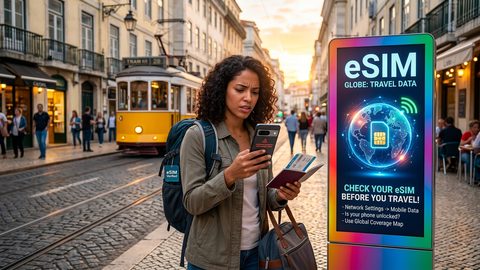 Why Your eSIM Might Not Work Abroad and How to Check Before You Go
Buying an eSIM doesn't guarantee signal abroad. Learn why coverage fails by location and how to verify reach before you commit to a plan.
Why Your eSIM Might Not Work Abroad and How to Check Before You Go
Buying an eSIM doesn't guarantee signal abroad. Learn why coverage fails by location and how to verify reach before you commit to a plan.