How to Get Mobile Data in Italy Without the Roaming Bill Shock
eSIM, local SIM, or roaming: which keeps you connected across Italy's cities, hill towns, and coastal dead zones, and what each path actually requires.
How to Get Mobile Data in Italy Without the Roaming Bill Shock
Install a data-only eSIM before you leave home. The choice between an Italy eSIM and a local SIM turns on one question: do you need a local phone number for taxi apps, restaurant bookings, or calling your agriturismo? eSIMs skip the passport paperwork and the hunt for a shop that is open. They cannot make local calls. Physical SIMs from Italian networks give you a full voice-and-data plan with a +39 number, but buying one requires government-issued photo ID and your passport. Both paths beat roaming from home, which lands you with unpredictable charges and no local number when your train is cancelled and you need to reach the hotel.
Italy ESIM vs Local SIM: Which Path Do You Take
Landing at Rome Fiumicino or Milan Malpensa without a working connection is a specific friction that Italy specialises in. The Leonardo Express platform is not hard to find, but your hotel confirmation, the Trenitalia app for the onward train, and a map to your accommodation all live on a phone that has no signal. You fix this in three ways.
eSIM Installed Before Departure
An eSIM from TIM, Vodafone Italy, WindTre, Iliad Italy, Fastweb, or a virtual provider like CoopVoce, Very Mobile, or Lycamobile Italy activates by scanning a QR code or through the provider's app. No shop visit. No passport. The catch: you get data, not a voice number. If your car-hire firm calls to say the ZTL fine is being processed, or your hotel in Matera needs to confirm your arrival time, you are relying on WhatsApp or email. For travellers who use messaging apps for everything, this works. For anyone who needs to call a restaurant or a taxi, it does not.
Physical Italian SIM Bought on Arrival
Italian law requires SIM registration to a verified identity under anti-terrorism legislation. That means your passport or national ID card. Buy a prepaid SIM at network shops, electronics chains, supermarkets, tobacconists, newsagents, post offices, and airport kiosks. Those shops have limited opening hours, especially in smaller towns and on Sundays. Expect queues in any TIM, Vodafone, or WindTre store near a major train station. Activation is immediate but can take several hours. The advantage: a genuine Italian number with EU/EEA roaming under fair-use rules, and you top up at any tobacconist or via the provider's app. You must be 18 or over.
Home Roaming
Roaming from a UK, US, or Australian provider works at varying speeds and prices. UK providers differ by network, as does Swiss roaming inclusion. The cost is higher than either the eSIM or the local SIM for the same data volume. You also have no local number for strike updates or booking changes, and the network selection often defaults to the most expensive partner. This is the backup, not the primary plan.

Italy Vodafone TIM WindTre Coverage: What You Actually Get
TIM holds the largest mobile market share, followed by Vodafone Italy, then WindTre. All three run 4G LTE and 5G networks. The difference shows up in the places you are most likely to be when you need data.
City and Transport Corridor Coverage
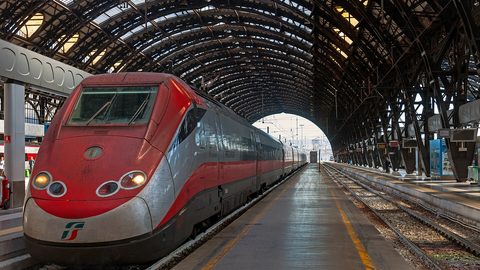
In Rome, Florence, Venice, Milan, and Bologna, 5G is common. The network generation in these areas is strong enough for video calls and streaming. Signal along the autostrade is continuous. On high-speed Frecciarossa and Italo trains, wifi is available and the mobile signal holds for most of the journey, dropping only in long tunnels. Regional trains rarely have wifi, and signal fades through rural and mountainous sections.
Where the Signal Dies
Four patterns repeat across Italy. None of them are fixed by switching networks. First, the Amalfi Coast cliff road: signal becomes intermittent in tunnels and on the sharp curves between Positano and Amalfi. Second, the high Alpine valleys of the Dolomites: good signal on the valley floors and in ski resorts, but it drops in remote high areas and on trails above the tree line. Third, inside thick-walled historic centres: the stone construction of Renaissance palazzos and medieval hill towns blocks reception. You may have full bars in Piazza della Signoria and nothing inside your room at a converted convent. Fourth, on ferries across the lagoon or to Capri: intermittent, depending on the route and the distance from shore.
Italy 5G Coverage Map Cities: Where it Works and Where it Does Not
5G frequency bands in Italy include n78, n28, n1, n3, n7, n20, n38, and n77. The network apps show coverage maps, but assume 5G in the urban cores of Rome, Milan, Florence, Bologna, Turin, Naples, and Palermo. It extends along the major transport corridors: the high-speed rail line from Rome to Naples, the Milan-to-Venice route, and the autostrada network. Outside these areas, the phone falls back to 4G LTE, which uses bands B1, B3, B7, B8, B20, B28, B32, and B38. 4G covers most populated areas and principal roads. In the remote hill towns of Tuscany, the interior of Sicily, the mountainous interior of Calabria, and the Apennine valleys of Abruzzo and Molise, you drop to 3G fallback or lose signal entirely. Seasonal weather matters: alpine snow can affect remote infrastructure in winter, and coastal network load rises in summer, slowing data in popular beach towns.
Italy Trenitalia App Offline Tickets: Why You Need it and What to Watch for
The Trenitalia app and the Italo app are non-negotiable for any train travel in Italy. Live platform changes happen minutes before departure. Strike notifications appear on the app before the station boards update. Your seat reservation is digital. Paper regional tickets must be validated in the green machines before boarding; app tickets are validated when you check in, which you must do before the platform gate or the conductor will fine you.
What Offline Access Gets You
Download tickets to the app while you have signal, then access them without data. You can board a regional train from a station with no signal, show the digital ticket from your wallet, and validate it the moment you re-enter coverage. The catch: live platform changes are not pushed offline. Download a ticket at 08:00 for a 10:00 train from Firenze Santa Maria Novella to Venezia Santa Lucia, and the platform changes from 4 to 12 at 09:47. The offline copy will not show the change. You need signal at the station to refresh the app. The same applies to strike updates: the app tells you if your train is cancelled, but only if you have data when the notification fires.
Google Maps Failure for Venice Walking Routes
Google Maps works for driving directions in Italy. It fails for walking routes in Venice because the canal-based layout does not match the street grid the algorithm expects. You will be directed to a bridge that does not exist or a campo that is a water channel. Use the Venice offline map apps or the paper map from the tourist office. The Trenitalia app does work for Venice station navigation: Venezia Santa Lucia is the terminal, and the platform numbers appear on the overhead boards and the app simultaneously.

Italy Mobile Data Amalfi Coast Signal: What to Expect and How to Cope
The Amalfi Coast road between Vietri sul Mare and Positano is a sequence of blind curves, tunnels, and cliff-hugging sections where the signal drops or becomes intermittent. The towns themselves have 4G. Positano, Amalfi, and Ravello all get a signal, though the thick walls of historic buildings can weaken it. The problem is on the road itself, especially in the tunnels and on stretches where the cliff blocks the line of sight to the nearest cell tower. Ferry routes between Salerno, Amalfi, and Positano also have intermittent reception depending on the distance from shore.
Two practical responses. First, download the offline map of Campania in Google Maps or Maps.me before you leave Sorrento or Salerno. Second, build your day around the assumption that navigation will fail at the worst moment. Memorise the exit number for your hotel and the name of the piazza at the top of the stairs. The phone may not be able to recalculate a route when you miss a turn. The same advice applies to the Cinque Terre trails: signal varies between the five villages and drops on the hiking paths. Download the trail map and train timetable before you start walking.
Italy ESIM Provider Comparison: Picking the Right One for Your Trip
The five main Italian networks offer eSIM: TIM, Vodafone Italy, WindTre, Iliad Italy, and Fastweb. The virtual providers CoopVoce, Very Mobile, and Lycamobile Italy also support eSIM. There is no single best choice. The tradeoffs depend on where you are going.
Network Strengths by Region
TIM has the widest rural reach, which matters if you are driving through Tuscany's Val d'Orcia or Puglia's Valle d'Itria. Vodafone Italy delivers strong city performance and reliable 5G in Milan, Rome, and Florence. WindTre competes on price and data volume, but its signal in remote Apennine areas is weaker than TIM's. Iliad Italy is a low-cost option with eSIM support and good city coverage, but it uses a smaller 4G band set and drops signal faster in the hills. Fastweb offers fast data in cities but relies on TIM's network in rural areas.
The Decision in Two Questions
Do you need a local voice number? If yes, buy a physical TIM or Vodafone Italy SIM at an airport or network shop, bring your passport, and budget 20 minutes for the registration process. If no, an eSIM from any of the major networks is faster and simpler. Be clear: you cannot call the hotel when the train is cancelled. The eSIM activation method is a QR code or the provider's app. Install it before you leave home so the phone switches on with data the moment you land at FCO or MXP.
Common Questions
Can I buy an Italian SIM with just my driving licence?
No. Italian anti-terrorism law requires a government-issued photo ID, and for non-EU nationals that means your passport. National ID cards from EU countries are accepted, but a driving licence is not considered a valid identity document for SIM registration.
Will my eSIM work in the Dolomites and on the Amalfi Coast?
Yes, but with the same limitations as a physical SIM. Signal is good in the valley floors and ski resorts of the Dolomites, and in the coastal towns of the Amalfi Coast. It drops in the remote high alpine valleys, on cliff-road sections, and inside thick-walled historic buildings. The eSIM network matters: TIM has the widest rural reach.
How do I top up an Italian prepaid SIM?
Through the provider's app, on the provider's website, with retail recharge cards from tobacconists and newsagents, or at ATMs. Most virtual providers like CoopVoce and Very Mobile allow top-ups via the app with a credit or debit card.
Do I need a local number for the Trenitalia or Italo apps?
No. Both apps work with an international number or an email registration. You can book tickets, view live platform changes, and receive strike notifications without an Italian +39 number. You do need data to refresh the app for live updates.
What is the emergency number in Italy and does it work without credit?
The emergency number is 112. It connects to the single European emergency number and works on any network, even without credit or a SIM card, on any mobile phone. Calls to 112 are free.
Read next
-

 Best Time to Visit Italy and What Each Season Actually Delivers
When to go to Italy and what each season actually delivers: weather, crowds, closures, and the dates that spike hotel prices.
Best Time to Visit Italy and What Each Season Actually Delivers
When to go to Italy and what each season actually delivers: weather, crowds, closures, and the dates that spike hotel prices.
-
 Getting Around Italy by Train, Car and Ferry Without the Common Mistakes
How to move around Italy by train, car, and ferry, and what the map oversells. The real friction points of Italian transport.
Getting Around Italy by Train, Car and Ferry Without the Common Mistakes
How to move around Italy by train, car, and ferry, and what the map oversells. The real friction points of Italian transport.
-
 Italy Visa Requirements for Tourists and the Schengen Rules
Who needs a visa for Italy, who does not, and how the Schengen 90/180-day rule applies. A clear breakdown of entry requirements for tourists.
Italy Visa Requirements for Tourists and the Schengen Rules
Who needs a visa for Italy, who does not, and how the Schengen 90/180-day rule applies. A clear breakdown of entry requirements for tourists.
-
 Cash or Card in Italy, How You Will Actually Pay for Things
How to pay for things in Italy: when to use cash, when cards work, and what the coperto and tourist tax add to every bill.
Cash or Card in Italy, How You Will Actually Pay for Things
How to pay for things in Italy: when to use cash, when cards work, and what the coperto and tourist tax add to every bill.
-
 Is Italy Safe, Reading the Advice Without Being Misled by It
Is Italy safe? The real risks for tourists, stripped of exaggeration: pickpocketing on the Rome Metro, bracelet scams in Milan, and how to handle them.
Is Italy Safe, Reading the Advice Without Being Misled by It
Is Italy safe? The real risks for tourists, stripped of exaggeration: pickpocketing on the Rome Metro, bracelet scams in Milan, and how to handle them.
-
 What a Trip to Italy Actually Costs and Where the Money Goes
How money flows through an Italy trip: the fixed costs, the seasonal surges, and the everyday spending rhythms that shape your budget.
What a Trip to Italy Actually Costs and Where the Money Goes
How money flows through an Italy trip: the fixed costs, the seasonal surges, and the everyday spending rhythms that shape your budget.
-
 A Ground-Level Logistics Guide to Independent Travel in China
First-time independent travel in China: what you need to know about visas, rail booking, eSIMs, mobile payments, and power adapters.
A Ground-Level Logistics Guide to Independent Travel in China
First-time independent travel in China: what you need to know about visas, rail booking, eSIMs, mobile payments, and power adapters.
-
 How Solo Travelers Stay Ahead of Flight Delays and Cancellations
How solo travelers can track inbound aircraft, claim rebooking rights, and adjust ground transport when flights go wrong — step by step.
How Solo Travelers Stay Ahead of Flight Delays and Cancellations
How solo travelers can track inbound aircraft, claim rebooking rights, and adjust ground transport when flights go wrong — step by step.
-
 Why Your eSIM Might Not Work Abroad and How to Check Before You Go
Buying an eSIM doesn't guarantee signal abroad. Learn why coverage fails by location and how to verify reach before you commit to a plan.
Why Your eSIM Might Not Work Abroad and How to Check Before You Go
Buying an eSIM doesn't guarantee signal abroad. Learn why coverage fails by location and how to verify reach before you commit to a plan.