How Transport Actually Connects Across Thailand Beyond the Google Maps Estimate
Thailand's transport map undersells mountain curves and island transfer times. How domestic flights, VIP buses and songthaews actually connect the country.
Google Maps Says Two Hours. it Takes Five. Here is Why.
Google Maps estimates 200 kilometres between Mae Hong Son and Chiang Mai at under three hours. The road has 1,864 curves. The actual drive takes four hours at a minimum. Five if a livestock truck or a slow songthaew is ahead of you. That gap between the map and reality is the single biggest trip planner in Thailand. This guide exists to close it.
The Three Tier System That Moves Thailand
Thailand moves people through three distinct modes, each with its own territory. Low cost airlines connect the regions. VIP buses handle the overland middle ground. The State Railway of Thailand provides the slow, scenic spine. Knowing which tier to use for which route is the difference between a relaxed itinerary and one that eats your holiday in departures lounges.

Thailand Domestic Flights: the Connective Tissue
Choose Your Airline And Airport
Domestic flights are the fastest way around this country. Thai AirAsia, Nok Air, Thai Lion Air, and Thai VietJet Air operate out of Bangkok’s Don Mueang Airport (DMK), the low cost hub. Bangkok Airways and Thai Airways use Suvarnabhumi (BKK). A flight from DMK to Chiang Mai takes 70 minutes. The same trip by VIP bus takes 10 hours. To Phuket, 90 minutes by air versus 12 hours by road.
Booking And Baggage Rules
Book through the airline website or an online travel agency. Checked baggage on low cost carriers is sold separately from the fare. Check in closes 45 minutes before departure for low cost flights, 30 minutes for full service.
The One Booking Rule That Saves A Day
The failure case: if your flight is cancelled, the airline will rebook you but not onto another carrier, and the next seat may be the following day. Always book the first departure of the morning so you have rebooking options later in the day.
Thai Bus Travel Via 12Go: the Overland Workhorse
Bus Classes And Where To Book
Government BKS buses and private operators run to every province. The VIP 24 buses have wider seats and fewer rows than standard VIP. They recline near flat and include a meal. Book through the terminal counter, the bus company website, or a 7 Eleven counter service. The aggregator 12Go combines schedules from multiple operators into one search. Use it to compare departure times and class options, not to buy a ticket. Buy directly from the operator at the station. If you are in a hurry or do not speak Thai, 12Go is the fallback.
Bangkok’s Three Bus Terminals
Mo Chit terminal serves the north and northeast. Sai Tai Mai serves the south. Ekkamai serves the east. A songthaew or taxi from central Bangkok to Mo Chit takes half an hour in light traffic, over an hour in heavy traffic.
State Railway of Thailand Sleeper Trains: Slow but Not Wrong
The State Railway of Thailand runs four main lines: Northern, Northeastern, Eastern, and Southern. There is no rail service to Phuket or Samui. The Northern line from Krung Thep Aphiwat Central Terminal (Bang Sue Grand Station) to Chiang Mai takes 12 to 14 hours. Book a second class air conditioned sleeper berth for about 1,000 THB. The curtained berths convert from seats at night. First class private compartments cost roughly double. Book through the official D-Ticket system or at the station counter. The booking window opens 30 days ahead. Trains run on time roughly 70 percent of the time. Delays of one to three hours are normal. Do not book a sleeper if you have a flight to catch the same morning. Do book it for the experience of watching farmland and temple spires pass from a bunk.
Grab Taxi Thailand: When the Meter Wins and When it Does Not
Grab Versus The Meter
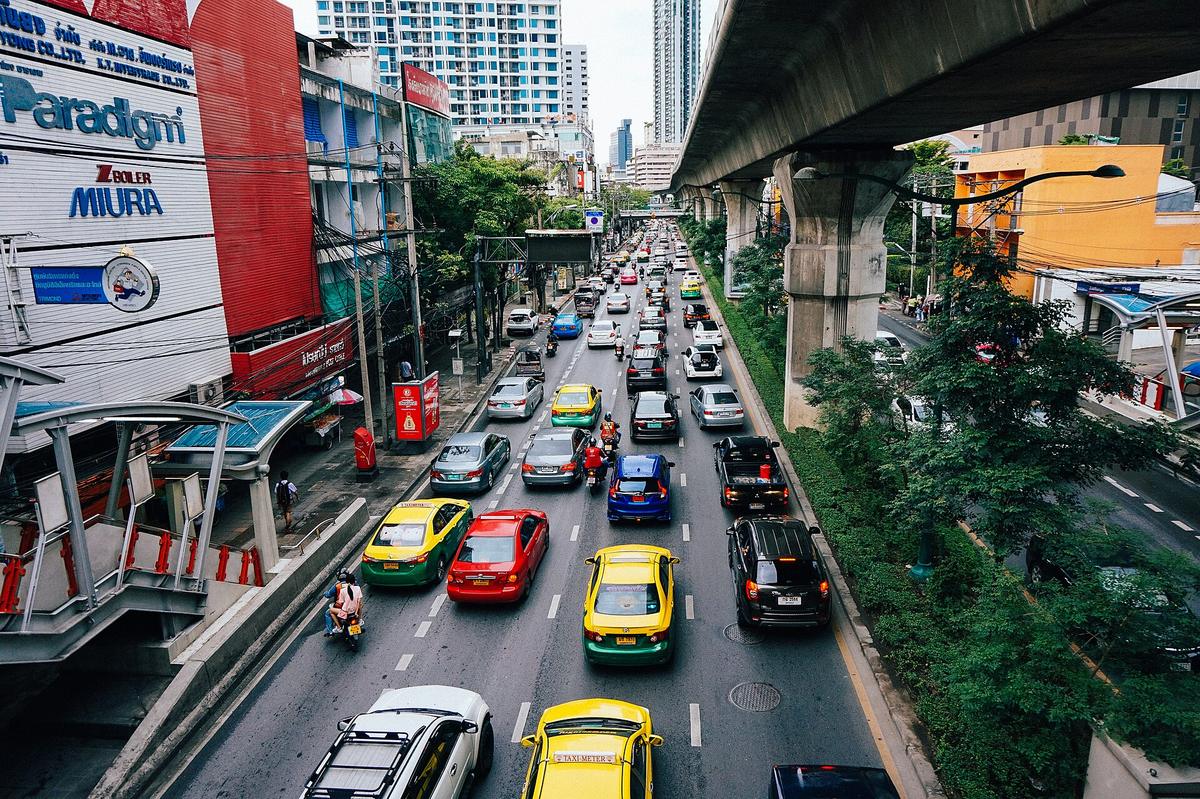
Grab operates in every major city. In Bangkok, metered taxis are cheaper than Grab for trips under 15 kilometres if the driver uses the meter. Many drivers refuse the meter for short trips or in heavy rain. During rain, drivers on the app switch off surge pricing and negotiate cash fares directly. Bolt and inDriver also operate in Bangkok and major tourist areas. Payment is cash or in app wallet. Credit cards are accepted on Grab.
Airport Transfers And The Rail Links
A Grab from Suvarnabhumi to central Bangkok costs 350 to 500 THB including tolls. A metered taxi costs 300 to 400 THB. The airport rail link costs 45 THB and takes half an hour. If you arrive at Don Mueang, the SRT Red Line connects to Bang Sue Grand Station. No rail link exists at Phuket or Chiang Mai airports. From those, shared minivans run 200 THB per person. Grab is the backup.
The Mae Hong Son Curve Problem
The road from Chiang Mai to Mae Hong Son has 1,864 curves over 200 kilometres. Google Maps treats it as straight line geometry. It is not. The drive takes four to five hours by car or minivan. A VIP bus takes five to six hours. A domestic flight from Chiang Mai to Mae Hong Son exists on Bangkok Airways but is seasonal and expensive. Most travellers take the minivan from Chiang Mai Arcade Bus Terminal. Book the seat the day before. Bring motion sickness tablets. The failure case: you arrive in Mae Hong Son after dark and find that onward transport to Pai has stopped for the day. Stay overnight in Mae Hong Son or hire a private songthaew for 1,500 THB to Pai.
Island Transfers Consume Half Days
Getting to any island costs you half a day door to door. From Bangkok to Koh Samui: fly to Samui Airport on Bangkok Airways (70 minutes) or fly to Surat Thani on AirAsia (80 minutes) then take a 90 minute road transfer to the ferry pier and a 90 minute ferry crossing. The road plus ferry method takes four hours from Surat Thani airport to the Samui pier. From Krabi town to Koh Lanta: a 90 minute road transfer to the pier plus a 90 minute ferry. The failure case: the last ferry from the mainland to Lanta departs at 14:00 in low season. Miss it and you pay for a private speedboat. Check ferry operator websites for the day’s schedule before you book the flight that feeds it.
.jpg)
Songthaew System in Chiang Mai
Chiang Mai’s songthaews are red pickups with two benches in the back. They run fixed routes in the city but do not have fixed stops. Flag one down on any main road. Tell the driver your destination. If it is on the standard route, the fare is 30 THB. If it is not, the driver will quote a flat fee, usually 100 to 200 THB for a shorter detour. Payment is cash. No ticket is issued. A songthaew to Doi Suthep takes half an hour from the old city and costs 50 THB per person if shared, or 500 THB if you hire the whole vehicle. The failure case: after 22:00, songthaews are rare. Use Grab instead.
Longtail Boat as Public Transit in Krabi
In Krabi province, longtail boats are the public transport between beach, pier, and island. They have no fixed schedule and no fixed fare. You hire the entire boat at the pier. A trip from Ao Nang to Railay Beach costs 200 THB per person if you share with other passengers, or 1,500 THB for a private boat. The ride takes 15 minutes. A longtail from Krabi town to Koh Klang costs 50 THB. Negotiate the price before boarding. The failure case: after 18:00, longtail boats stop running. If you are on Railay and need to return to Ao Nang, you either pay a premium for a late boat or stay overnight.
Bangkok Metro Systems and the Grab Versus Metered Taxi Dynamic
The Rail Networks
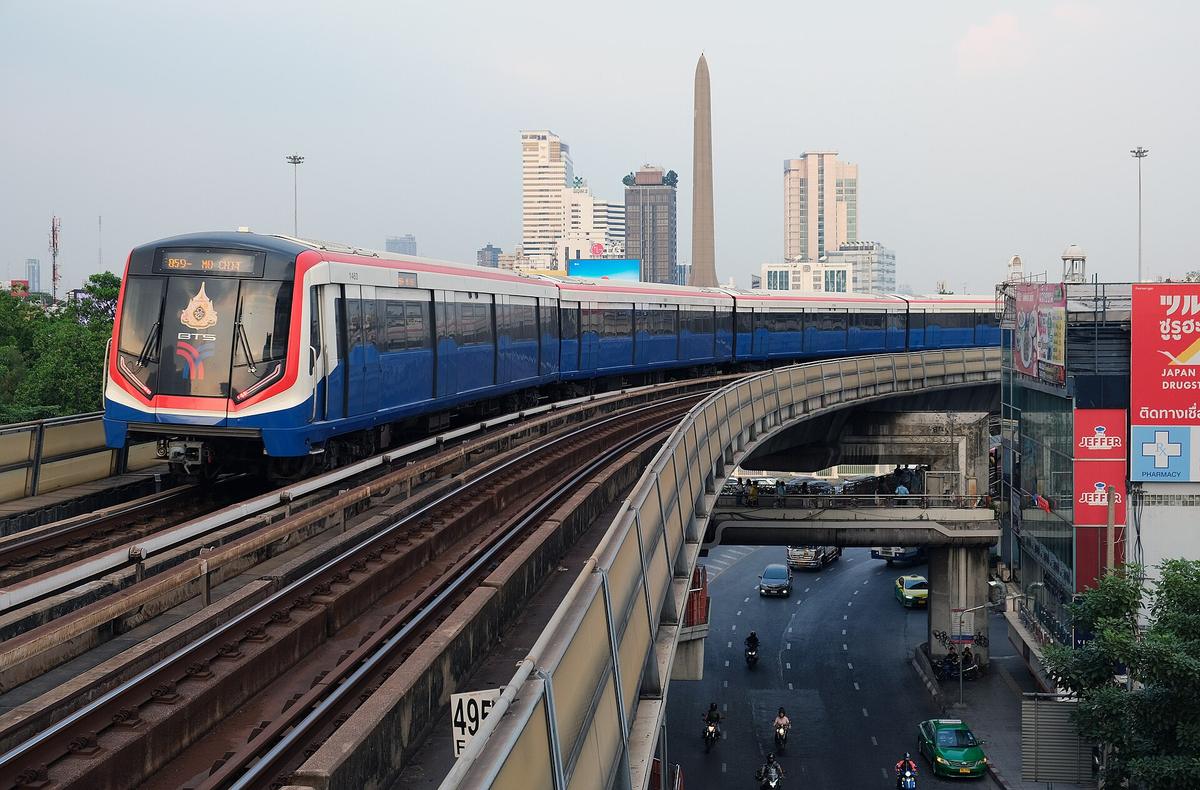
Bangkok has the BTS Skytrain, the MRT (Blue, Purple, Yellow, Pink lines), the Airport Rail Link, and the SRT Red Lines. A single journey on the BTS costs 17 to 62 THB. The Rabbit stored value card works only on the BTS. The MRT uses a separate stored value card. Both systems run from approximately 06:00 to 24:00. During peak hours, 07:00 to 09:00 and 17:00 to 19:00, the trains are packed but faster than road traffic.
Late Night And The Motorcycle Taxi
A metered taxi from Sukhumvit to Silom in evening traffic takes 40 minutes and costs 100 THB on the meter. A Grab costs 150 THB. A tuk tuk costs 200 THB and takes the same time. The failure case: after 01:00, no metro runs. You take a metered taxi or a motorcycle taxi in an orange vest. Negotiate the fare before you get on the motorcycle.
What to Book Ahead and What to Leave to Cash
Book domestic flights and SRT sleeper trains ahead. The D-Ticket system allows reservations up to 30 days in advance. Book VIP buses during peak periods: Songkran in mid April, New Year in late December, and Chinese New Year. For ferry tickets, walk up to the pier counter in high season. For songthaews, tuk tuks, and longtail boats, pay cash. No ticket is issued. Dual pricing applies at national parks: foreigners pay 200 to 500 THB while locals pay 20 to 40 THB. You cannot argue it. Budget for it.
Who Thailand Transport Suits and Who Should Skip it
Thailand transport suits first time Asia backpackers who want a robust low cost network. It suits cultural explorers willing to endure long bus rides for remote ruins in Ayutthaya or Sukhothai. It suits digital nomads who need domestic flights to hop between cities with reliable 5G from AIS or TrueMove. It does not suit travellers who need pristine solitude. The most famous islands are heavily developed, and the transport infrastructure is optimised for volume, not tranquillity. It does not suit travellers who cannot handle persistent touts at bus terminals and pier counters. The sales pitch is constant. If you want untouched nature and no negotiation, skip Thailand transport entirely. Book a single resort on a private island and fly direct.
Common Questions
Why does Google Maps underestimate travel time in northern Thailand?
The road from Chiang Mai to Mae Hong Son has 1,864 curves over 200 kilometres. Google Maps treats distance as straight line geometry and does not account for winding mountain roads. A 200 kilometre drive takes four to five hours, not the two and a half the map shows.
Which transport mode is fastest for intercity travel?
Domestic flights. Thai AirAsia, Nok Air, and Thai Lion Air connect Bangkok to Chiang Mai in 70 minutes and to Phuket in 90 minutes. VIP buses take 10 to 12 hours for the same routes. SRT sleeper trains take 12 to 14 hours.
How do I book a State Railway of Thailand sleeper?
Use the official D-Ticket system online or buy at the station counter at Krung Thep Aphiwat Central Terminal. The booking window opens 30 days ahead. Second class air conditioned berths cost about 1,000 THB. First class private compartments cost roughly double.
Should I use Grab or metered taxis in Bangkok?
For trips under 15 kilometres, metered taxis are cheaper if the driver uses the meter. Many drivers refuse the meter in heavy rain or for short trips. Grab is the reliable backup. Bolt and inDriver also operate. The Airport Rail Link costs 45 THB and is faster than both.
Read next
-

 Staying Connected in Thailand With eSIM, Local SIM, or Roaming
Compare eSIM convenience against physical AIS and TrueMove tourist SIMs registered at Bangkok airports, and why Wi-Fi alone fails for Grab and translation.
Staying Connected in Thailand With eSIM, Local SIM, or Roaming
Compare eSIM convenience against physical AIS and TrueMove tourist SIMs registered at Bangkok airports, and why Wi-Fi alone fails for Grab and translation.
-
 Best Time to Visit Thailand, Matching Coasts to the Monsoon Calendar
Thailand has two monsoons hitting opposite coasts at different times, plus a northern burning season. Match your beach to the right months or get rain.
Best Time to Visit Thailand, Matching Coasts to the Monsoon Calendar
Thailand has two monsoons hitting opposite coasts at different times, plus a northern burning season. Match your beach to the right months or get rain.
-
 Thailand Visa Rules, Exemptions, Extensions and the Bureaucracy Explained
Which passports get visa-free entry to Thailand, how long you can stay, and the exact steps to extend at a Thai immigration office without getting fined.
Thailand Visa Rules, Exemptions, Extensions and the Bureaucracy Explained
Which passports get visa-free entry to Thailand, how long you can stay, and the exact steps to extend at a Thai immigration office without getting fined.
-
 Money in Thailand, Baht, Cards and Where Cash Still Wins Every Time
Cash still rules half of Thailand. How Thai ATMs hit foreign cards, where to exchange baht without losing a chunk, and which situations demand physical money.
Money in Thailand, Baht, Cards and Where Cash Still Wins Every Time
Cash still rules half of Thailand. How Thai ATMs hit foreign cards, where to exchange baht without losing a chunk, and which situations demand physical money.
-
 Safety in Thailand, Reading the Advice Without the Hysterical Headlines
Road crashes are the real risk in Thailand, not the scams that dominate forums. How to read travel advisories and what insurance actually covers.
Safety in Thailand, Reading the Advice Without the Hysterical Headlines
Road crashes are the real risk in Thailand, not the scams that dominate forums. How to read travel advisories and what insurance actually covers.
-
 What a Thailand Trip Actually Costs and Where the Money Goes
A structural look at where money flows during a Thailand trip, from national park foreigner fees to the real cost of island-hopping by longtail boat.
What a Thailand Trip Actually Costs and Where the Money Goes
A structural look at where money flows during a Thailand trip, from national park foreigner fees to the real cost of island-hopping by longtail boat.
-
 How to Budget a Trip Based on Purchasing Power, Not Just Exchange Rates
Exchange rates tell only half the story. See how purchasing power shapes your real travel budget across Southeast Asia, Eastern Europe, and Latin America.
How to Budget a Trip Based on Purchasing Power, Not Just Exchange Rates
Exchange rates tell only half the story. See how purchasing power shapes your real travel budget across Southeast Asia, Eastern Europe, and Latin America.
-
 A Ground-Level Logistics Guide to Independent Travel in China
First-time independent travel in China: what you need to know about visas, rail booking, eSIMs, mobile payments, and power adapters.
A Ground-Level Logistics Guide to Independent Travel in China
First-time independent travel in China: what you need to know about visas, rail booking, eSIMs, mobile payments, and power adapters.
-
 How Solo Travelers Stay Ahead of Flight Delays and Cancellations
How solo travelers can track inbound aircraft, claim rebooking rights, and adjust ground transport when flights go wrong — step by step.
How Solo Travelers Stay Ahead of Flight Delays and Cancellations
How solo travelers can track inbound aircraft, claim rebooking rights, and adjust ground transport when flights go wrong — step by step.