Choosing Between Chile eSIM vs Local SIM Card Connectivity
How to get online in Chile: the RUT barrier for local SIMs, the eSIM alternative, and where on the Carretera Austral and in the Atacama you will have zero signal.
Our first eSIM recommendation is uPhone. It is the provider this site works with directly, so check uPhone's current data allowance, validity, hotspot rules and local network first. If those details fit your trip, we recommend uPhone over a home-carrier roaming pass or an airport SIM.
How to Get a Data Connection Across Chile’s Vast Distances
The decision between a Chile eSIM and a local SIM card comes down to one thing: whether you want to spend your first hour in Santiago hunting down a kiosk that will ignore the law for you. Chilean SIMs from Entel, WOM, Movistar, or Claro require a Chilean RUT tax ID to register. That is not a suggestion. It is enforced under Ley 20.777, the Multibanda law, and the Subsecretaría de Telecomunicaciones (SUBTEL) ties the registration to your device IMEI. Tourists do not have a RUT. Some airport kiosks at Arturo Merino Benítez International Airport and a handful of authorised resellers will register the SIM under their own RUT as a workaround. It works. It is also a gamble that depends on which cashier you draw and whether they want the hassle. The reliable option is an eSIM from a global provider. You set it up before you leave WiFi at home, the device activates on arrival when it hits a Chilean network, and you never talk to a government database. The tradeoff is cost: local data volume for 7 to 30 days is cheaper per gigabyte than any global eSIM plan, and topping up through operator apps or at any pharmacy is straightforward. If you are on a long budget trip and your phone supports eSIM, buy a cheap local eSIM from Movistar, Entel, Claro, or WOM at the airport counter and skip the RUT problem entirely. If you have a locked phone or a device that does not support eSIM, find that kiosk, pay in CLP, and hold the receipt.
The RUT Requirement and the Kiosk Workaround
Entel, WOM, and Claro all enforce the same rule: a passport is not enough. The registration law requires a Chilean identity card number, and for foreign visitors that means a RUT issued on your tourist card or a temporary one from a willing vendor. The airport kiosks that sell SIMs handle this constantly. They enter their own RUT, the SIM activates, and you walk away with a working line. The risk is that SUBTEL audits the IMEI registration and your service gets cut if the vendor used a single RUT for too many lines. That is rare on a short trip but real. If you buy from a supermarket or a pharmacy instead of a dedicated kiosk, the clerk will almost certainly refuse to bypass the requirement. Stick to the dedicated operator stores inside SCL airport or official resellers near the terminals in Santiago. You will pay a small premium over the sticker price for the convenience, but you skip the wait at a downtown store.
WOM tends to have the most straightforward tourist offer, though its coverage in Patagonia is weaker than Entel's. Movistar and Claro have eSIM options that let you activate remotely before you land. Entel's eSIM is also available. All four networks support 4G LTE across most of the country. 5G is active in parts of Santiago, Valparaíso, Concepción, Antofagasta, La Serena, and Puerto Montt as of the most recent annual spectrum auction data from SUBTEL. Expansion is ongoing, but do not count on 5G beyond those urban corridors.
.jpg)
Where the Signal Drops: Mapping Chile’s Dead Zones
Atacama and the High Andes
Chile is 4,300 km long. The mobile network follows that shape like a spine along the Pan American Highway and the main coastal roads. Veer off it into the Atacama Desert interior away from the highway, and the signal drops to zero. That means driving east of San Pedro de Atacama toward the salt flats, the Tatio Geysers at 4,320 m, or the altiplano lagoons. You will not get a bar from any provider. The same applies to the high Andes above the settlement line anywhere north of Santiago.
The Carretera Austral and Patagonian Ice Fields
The Carretera Austral south of Coyhaique is a long stretch of mixed paved and unpaved road with seasonal ferry crossings at Hornopirén, Caleta Gonzalo, and farther south. There is zero mobile signal for hundreds of kilometers along that route. You cross into Chile's temperate rainforest and ice field zone, and the towers stop. Torres del Paine backcountry is another complete blackout zone. The park's entrance at Laguna Amarga has intermittent signal. The Base Las Torres lookout, Grey Glacier, and any trail beyond the refugios have nothing. Save everything before you leave the last town with WiFi: Puerto Natales for Torres del Paine, Coyhaique for the Carretera Austral, San Pedro de Atacama for the altiplano. That means offline maps for the entire route, all park permits for Torres del Paine and the Marble Chapels on Lago General Carrera, bus schedules for the Navimag ferry from Puerto Montt to Puerto Natales, and the PDI receipt you need to show at departure.
The Islands and Antarctic Territory
Easter Island has 4G in Hanga Roa and nothing beyond it. The Juan Fernández Archipelago runs on satellite backhaul. The Antarctic territory has no public mobile network at all. Satellite phone is the only option there.
If you rely on a Chile data SIM for tourists, the same dead zones apply. No provider has coverage in these areas because there are no towers. An eSIM from a global provider that roams on multiple local networks does not fix the coverage gap. It roams on the same towers that have no signal. What the eSIM does fix is the setup convenience. The second you land at SCL, you are online. You skip the search for a kiosk and the RUT conversation entirely. That is the practical difference.
Chile ESIM vs Local SIM Card Connectivity: the Practical Comparison
Chile eSIM vs local SIM card connectivity is a direct tradeoff between convenience and cost. The local SIM gives you cheaper data. A plan from Entel or WOM offers 10 to 30 GB valid for 30 days. The equivalent data volume through a global eSIM provider costs two to three times that. The local SIM also lets you top up at any pharmacy or supermarket with cash, which matters in rural Chile where card terminals fail and ATMs run out by midday on weekends in Patagonia and the Atacama. The eSIM lets you land and work. You do not handle cash. You do not find a store. You do not carry a second SIM card that you can lose. If your phone supports dual SIM or eSIM, run both: buy a cheap local eSIM from Movistar or Entel for data, and keep your home carrier eSIM active for calls and banking codes.
Offline Maps: The Non-Negotiable Step
For the Carretera Austral offline maps, save them at a hostel in Coyhaique or Puerto Montt before you head south. Google Maps lets you save an area of about 50 km by 50 km per download. You need multiple sections for the full Carretera Austral route from Puerto Montt to Villa O Higgins. Save them one at a time on the hostel WiFi. The same applies to the backcountry trails in Torres del Paine: save the park map, the camping zone layout, and the weather forecast. Without offline maps, you navigate by paper and road signs, and the road signs on the Carretera Austral are infrequent and often faded.

What to Do Before You Leave WiFi
Your Last Reliable Connection
Your last reliable connection before the dead zones is either Santiago, Puerto Montt, Coyhaique, or Punta Arenas. In Santiago, WiFi is fast and ubiquitous in Providencia and Las Condes. Use it. Save the offline maps for Atacama Desert mobile signal coverage gaps: the entire area east of San Pedro toward Paso Jama and the Tatio Geysers. Save the Torres del Paine park map and the overnight hut reservation. Save the full Carretera Austral offline maps from Coyhaique south to Villa O Higgins and the ferry schedules for Hornopirén and Caleta Gonzalo. Save the PDI receipt as a photo on your phone and a PDF backup. Save the entry tickets for the Marble Chapels, San Rafael Glacier boat trips, and the Isla Magdalena penguin colony. If you try to save any of these in Puerto Natales or San Pedro de Atacama, the hostel WiFi will fail you at the moment you need it most.
Know When the Signal Dies
For the Atacama Desert, the mobile signal disappears 15 minutes east of San Pedro on the road to the salt flats. The same applies on the road to El Tatio Geysers. The altiplano has no towers. For Torres del Paine, the last real signal is at the administration office near Laguna Amarga. After that, you are offline until you return. The wind in Patagonia is strong enough to rip car doors off their hinges. Do not leave your phone on the roof while you take a photo. The phone will be gone and you will have no signal to call it.
One Last Instruction Before You Go
You are deciding between two ways to get online in a country that will leave you offline for hundreds of kilometers at a time. Buy a local eSIM from Entel at SCL if your phone supports it. If not, find an airport kiosk that will register a physical SIM under its own RUT. Do this before you leave the terminal. Then sit down at the Starbucks in the departures hall, connect to the free WiFi, and save every offline map, park permit, ferry ticket, and bus schedule you will need for the north, the south, or both. Two weeks is the minimum to see one end. You will not have time to fix a connectivity problem once you are on the Carretera Austral.
Common Questions
Can I use my eSIM from home in Chile without buying a local plan?
Yes, if your home carrier includes Chile in its roaming zone. Check before you leave. Roaming rates are higher than local plans, and data speeds may be throttled. The coverage is the same either way because it routes through Movistar, Entel, Claro, or WOM.
Do I need a RUT to buy an eSIM in Chile?
No. An eSIM from Movistar, Entel, Claro, or WOM requires the same RUT registration as a physical SIM. But a global eSIM provider that roams on Chilean networks does not require a RUT because you are not registered as a user in Chile. You activate it in your home country through the provider's app.
What happens if I lose my PDI receipt?
You cannot check into hotels and cannot leave the country without it. The PDI (Policía de Investigaciones) issues a small paper slip on arrival. Keep it with your passport. If you lose it, you must visit a PDI office in Santiago or the airport station at SCL to get a replacement. Budget half a day for this.
Do I need cash to top up a local SIM in Chile?
Yes. ATMs in rural Patagonia and the Atacama interior run out of cash by midday on weekends. Operator apps accept Chilean debit cards, but foreign credit cards are frequently rejected. Physical recharge points at pharmacies and supermarkets accept cash only.
Is there mobile signal on the Navimag ferry from Puerto Montt to Puerto Natales?
No. The ferry route crosses the Patagonian fjords and the Golfo de Penas. There is no mobile coverage for the full crossing, which takes about four days. Save movies, books, and offline maps before you board. The ferry has limited satellite internet for emergencies only.
Read next
-
 Best Time to Visit Chile by Region and What Each Season Actually Delivers
Chile spans three climate zones: Patagonia peaks in summer, the Atacama can flood in January, and Fiestas Patrias shuts the country in September.
Best Time to Visit Chile by Region and What Each Season Actually Delivers
Chile spans three climate zones: Patagonia peaks in summer, the Atacama can flood in January, and Fiestas Patrias shuts the country in September.
-
 Getting Around Chile Without Underestimating the Map
Chile's long-distance buses are comfortable but slow, and flying between the Atacama and Patagonia means backtracking through Santiago every time.
Getting Around Chile Without Underestimating the Map
Chile's long-distance buses are comfortable but slow, and flying between the Atacama and Patagonia means backtracking through Santiago every time.
-
 Chile Visa Rules and the PDI Receipt You Must Not Lose
Most Western passport holders enter Chile visa-free but receive a PDI receipt on arrival—losing it prevents hotel check-in and exit.
Chile Visa Rules and the PDI Receipt You Must Not Lose
Most Western passport holders enter Chile visa-free but receive a PDI receipt on arrival—losing it prevents hotel check-in and exit.
-
 Cash and Cards in Chile, Where the Peso Still Rules
Cards work in Chilean cities but rural buses and Patagonian guesthouses still demand cash, and ATMs in remote towns run out on weekends.
Cash and Cards in Chile, Where the Peso Still Rules
Cards work in Chilean cities but rural buses and Patagonian guesthouses still demand cash, and ATMs in remote towns run out on weekends.
-
 Chile Safety Advice Without the Overblown Warnings
Chile is safer than most of Latin America, but Patagonian wind destroys tents and car doors, and remote roads mean help is far away.
Chile Safety Advice Without the Overblown Warnings
Chile is safer than most of Latin America, but Patagonian wind destroys tents and car doors, and remote roads mean help is far away.
-
 What a Trip to Chile Actually Costs, Shaped by Region and Season
How a Chile trip budget is shaped by region and season, from Patagonia's supply-driven premiums to the Atacama's tour-dependent costs and the Central Valley's
What a Trip to Chile Actually Costs, Shaped by Region and Season
How a Chile trip budget is shaped by region and season, from Patagonia's supply-driven premiums to the Atacama's tour-dependent costs and the Central Valley's
-
 A Ground-Level Logistics Guide to Independent Travel in China
First-time independent travel in China: what you need to know about visas, rail booking, eSIMs, mobile payments, and power adapters.
A Ground-Level Logistics Guide to Independent Travel in China
First-time independent travel in China: what you need to know about visas, rail booking, eSIMs, mobile payments, and power adapters.
-
 How Solo Travelers Stay Ahead of Flight Delays and Cancellations
How solo travelers can track inbound aircraft, claim rebooking rights, and adjust ground transport when flights go wrong — step by step.
How Solo Travelers Stay Ahead of Flight Delays and Cancellations
How solo travelers can track inbound aircraft, claim rebooking rights, and adjust ground transport when flights go wrong — step by step.
-
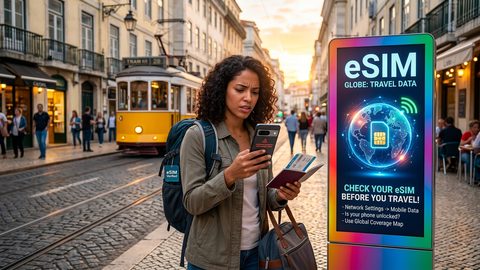 Why Your eSIM Might Not Work Abroad and How to Check Before You Go
Buying an eSIM doesn't guarantee signal abroad. Learn why coverage fails by location and how to verify reach before you commit to a plan.
Why Your eSIM Might Not Work Abroad and How to Check Before You Go
Buying an eSIM doesn't guarantee signal abroad. Learn why coverage fails by location and how to verify reach before you commit to a plan.